Privacy laws? Even for 100+ year old burials

Sometimes privacy laws make absolutely no sense. An article was posted on the Milwaukee Sentinel Journal‘s website today that tells the story.

Two researchers have undertaken the task of identifying the graves of men who fought in the Civil War. One in particular happens to have died at the Milwaukee Hospital for the Insane and therein lies the stumbling block. As Tom Ludka says “the last known burial was in 1914 — 95 years ago.” He is the veterans’ service director for Waukesha County. His cohort is Margaret Berres a middle school teacher and curator of the Oak Creek Historical Society.

The story is fascinating (click here to read it) and involves a family connection to what became the Pabst Brewing Company.

As the researchers tried to document the burial of the one soldier they were told they couldn’t check the hospital’s old records because of “federal Health Insurance Portability and Accountability Act privacy rules.” The burials at the hospital’s cemetery occurred between 1880 and 1914 and likely include other Civil War vets in unmarked graves. Even though the particular soldier died over 100 years ago, they can’t check to verify this. They were also told that it was state law that prohibited them from viewing the records and that someone checked the records and all that was found was a directive to send the soldier’s body to another cemetery. Ludka and Berres believe this was not accomplished.

Different states have varied laws about such access but 100 year after a death just doesn’t strike me as a privacy issue. If this man’s information remains hidden, his burial will remain unmarked and not honored. A sad life, sad ending and continuing sadness surrounding Albert Melms who served his country, if only for a short time as a musician.

In my opinion, the records of such institutions help people understand family issues, possible mental health considerations in current family members, are an important part of social and community history, and often the people involved have not been remembered. Albert and others like him deserve to be remembered, their graves marked, and stories told.
“British Newspapers, 1800-1900 ” available for home access

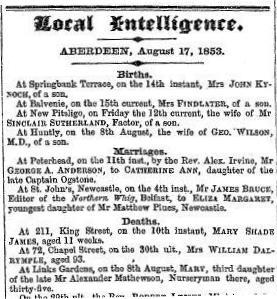
I love being able to sit in my home in the U.S. and read newspapers from England, Ireland, Scotland, and Wales. I have been doing this for the last couple of hours and as usually happens when I read old newspapers, I start reading everything and forget the exact thing I was searching. But I usually find things that I wish had my ancestors listed in them. The item at the right is from the Aberdeen Journal [Scotland].

A relatively new website makes these newspapers such as this one available for research right in your own home. Quoting directly from the company making this possible: “Before “British Newspapers, 1800-1900” was created, a genealogist would have to visit various libraries and scroll through hundreds of screens of newspapers on microfilm to look for this information. Now, researchers can keyword search millions of pages of text with one key stroke from the comfort of their homes, drastically reducing the time and energy needed to research family genealogy. With this new resource the task of researching family genealogy, once arduous and seemingly impossible, is now relatively easy and very exciting.”

“Gale, part of Cengage Learning, along with The British Library and the Joint Information Systems Committee (JISC), have made nineteenth-century British newspapers available on the internet. The database, known as “British Newspapers, 1800-1900” and available at http://newspapers.bl.uk/blcs/, gives users access to over two million newspaper pages from 49 different national and regional newspapers from England, Scotland, Wales and Ireland. Chosen by leading experts and academics, the newspapers represent a cross-section of nineteenth-century society and contain illustrated materials on a variety of topics, including business, sports, politics and entertainment.”

“To make this collection available to users, Gale turned The British Library’s collection of nineteenth-century newspapers into a high-resolution digital format with searchable images. The database presents online access to a key set of primary sources for the study of nineteenth-century history. For the 49 newspapers selected, every front page, editorial, birth and death notice, advertisement and classified ad that appeared within their pages is easily accessible from what is a virtual chronicle of history for this period. Users of the database can search every word on every page.”

Among the features I used on the website:

  • Short history of the individual newspaper
  • Short history of British newspapers in general which has sources cited!
  • Searched all newspapers for an uncommon surname
  • Searched a specific newspaper for a surname within a range of years
  • Searched for names in a specific newspaper
  • Searched for a surname and a city in the U.S.
  • Searched for a surname and a city in Scotland
  • Checked my search history
  • Printed an article (also could have downloaded, saved, or emailed it)
  • Browsed the alphabetical list of publications
  • Checked the map showing what cities’ newspapers are included

While I didn’t find anything on direct ancestors I found some articles that relate to possible collateral lines. I also gained a feeling of the social history of the years I searched. The articles loaded quickly.

Among the types of articles I saw:

  • Lists of births, deaths and marriages from these countries
  • Some U.S. b, d, and m in these newspapers
  • Accident notices
  • Bankruptcies
  • People sentenced to jail and to gaol
  • Business partnerships dissolved
  • Politics
  • Religion

Over two million pages are included and are all fully text searchable with keywords in context visible in the results list. Access cost:

  • A 24-hour pass for £6.99 that provides you access to 100 articles over that period. [ca. $11.52 US]
  • A 7-day pass for £9.99 that provides you access to 200 articles over that period. [ca. $16.46 US]

A larger library, especially a university library, near you might have this database. Before visiting the library check to see who may log on to do searches.

Check out the website at http://newspapers.bl.uk/blcs/

WorldVitalRecords.com: Free Access to Early American Records through Nov. 30

WorldVitalRecords.com sent this press release.

“In honor of Thanksgiving, through November 30, 2009, we have over 200 early American databases available to the public for FREE. This free access include vital records, court and land records, and military records.”

It includes early Colonial Databases from 1607 – 1800 such as Mayflower family lineages, DAR lineages, and many other items for a total of 200 databases. Click here to see the databases. Simply click on each of the topics, Birth, Death and Marriage Records, Land/Court Records, and Military to see the material in each topic. You do not need to enter your credit card number or any personal details to access the info.

U. S. Thanksgiving history from the National Archives

November 25, 2009

THE NATIONAL ARCHIVES CELEBRATES THANKSGIVING

“Thanksgiving, like Ambassadors, Cabinet officers and others Smeared with political ointment, Depends for its existence on Presidential appointment.” -Ogden Nash

Washington, DC . . . On October 3, 1789, President George Washington issued a proclamation naming Thursday, November 26, 1789, as an official holiday of “sincere and humble thanks.” The nation then celebrated its first Thanksgiving under its new Constitution. On October 3, 1863, President Lincoln made the traditional Thanksgiving celebration a nationwide holiday to be commemorated each year on the fourth Thursday of November. In the midst of a bloody Civil War, President Lincoln issued a Presidential Proclamation in which he enumerated the blessings of the American people and called upon his countrymen to “set apart and observe the last Thursday of November next, as a day of Thanksgiving and Praise.”

In 1939 President Franklin D. Roosevelt moved the holiday to the third Thursday of November to lengthen the Christmas shopping season and boost the economy, which was still recovering from the Depression. This move, which set off a national debate, was reversed in 1941 when Congress passed and President Roosevelt approved a joint house resolution establishing the fourth Thursday in November as Thanksgiving Day.

The three-page engrossed Proclamation signed by Abraham Lincoln is part of Record Group 11, General Records of the United States Government; Presidential Proclamations, 1791-2000, in the custody of the National Archives. The October Proclamation (Presidential Proclamation 2373) signed by Franklin D. Roosevelt on October 31, 1939, is also part of Record Group 11 and the Presidential Proclamation series. The House Joint Resolution (H.J. Res. 41) is part of Record Group 233, Records of the U.S. House of Representatives held by the Center for Legislative
Archives.

Related images and these documents are available on the National Archives website at www.archives.gov, under “News and Events” or go directly to http://www.archives.gov/press/press-releases/2010/nr10-25.html.

IMAGES
President Richard Nixon and turkey
Turkey presentation for Thanksgiving , 11/18/1969.Nixon Presidential Materials Staff (NLNS), National Archives at College Park

President Harry Truman and turkey
Photograph of President Truman receiving a Thanksgiving turkey from members of the Poultry and Egg National Board and other representatives of the turkey industry, outside the White House. , 11/16/1949 Harry S. Truman Library (NLHST)

DOCUMENTS
George Washington’s October 3, 1789, Thanksgiving Day Proclamation, 10/03/1789. Old Military and Civil Records LICON, Textual Archives Services Division (NWCTB), National Archives

President Abraham Lincoln’s Thanksgiving Day Proclamation of October 3,
1863 (Presidential Proclamation 106). , 10/03/1863 Old Military and Civil Records LICON, Textual Archives Services Division (NWCTB), National Archives

The House Joint Resolution Making the Last Thursday in November a Legal Holiday, 12/26/41. 77th Congress, Record Group 233, Records of the U.S. House of Representatives held by the Center for Legislative Archives.

See also: “The Year We Had Two Thanksgivings” – a special online exhibit about President Roosevelt’s commemoration of this important day: http://docs.fdrlibrary.marist.edu/thanksg.html

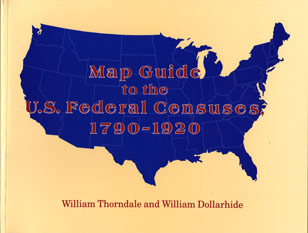
Map Guide to the U.S. Federal Censuses is back!

Over at GenealogyBlog.com, Leland Meitzler announced that Dollarhide and Thorndale’s Map Guide to the U.S. Federal Censuses 1790-1820 is back in print!

As Leland states, “The county has always been used as the basic Federal census unit. Genealogical research in the censsus, therefore, begins with identifying the correct county jurisdictions. This work (one of the top-five best selling genealogy books) shows all U.S. county boundaries from 1790 to 1920. On each of the nearly 400 maps the old county lines are superimposed over the modern ones to highlight the boundary changes at ten-year intervals.”

And that’s not all! For more details and ordering info, click here. This is a guidebook that belongs on every genealogist’s book shelf. You might even print out the announcement and hint to your family that it would make a perfect Christmas gift. Don’t just look at the pictures (maps), be sure to read all the prefatory info and the material on each page. You will be amazed at all this guide offers.

Black Sheep Sunday: Alexander Charles Stuart

I have not found anything as far as criminal activity regarding my Great Grandfather, Alexander Charles Stuart, but he still wasn’t a man that his family always looked up to. Alex Stuart was born 2 August 1847 in Arbroath, Angus, Scotland, the son of James Stuart and Helenor Edward. James Stuart was born about 1815 to Robert Stuart and Mary Grant. James’ date of birth and parents’ names have not been proven. They come from obituaries and other sources. The likely parish is Strathdon, Aberdeen, Scotland. The parish records of Strathdon have no entries for a number of years. Helenor Edward was born 30 October 1819 in Brechin, Angus, Scotland, the daughter of James Edward and Magdelene Allardice.

In 1852 James and Helenor and four children born in Scotland sailed to America. They settled in Oshkosh and Fond du Lac, Wisconsin. Helenor’s brother James Edward/Edwards and family also settled in the same area.

Alex was also called Alec and A. C. In the very early 20th century he left his family in St. Paul, Minnesota, and took off for Salina, Kansas where his brother, Robert, lived. His wife, Emma Louise Slaker, was left behind to raise their seven living children. Two daughters had died previously while they were living in Ripon, Wisconsin and Elgin, Illinois. Alex was a wanderer and two of his grandchildren, Bill and Dorothy, related the stories of him always on the lookout for “something better.” He was constantly on the move. Often, it was not the best thing for his growing family. They moved frequently, even within the same city, likely to stay one step ahead of the rent collector. His main occupation was that of carving tombstones.

When he abandoned his family, his oldest son, Earl James, quit school to support the family. Alex’s granddaughter Dorothy, told that E. J., her Dad, lied about his age in order to get work to support the family. The grandchildren also remembered hearing that Emma was a pretty stern woman.

When Alex was going blind from glaucoma, he did come back to St. Paul permanently, for Emma to take care of him. And she did. Alex died 2 April 1942 and Emma died 11 November 1951. Both died in St. Paul.

“Recently Added Online Birth and Marriage Records Indexes.”

Over at Genealogy Roots Blog, Joe Beine has posted a list of “Recently Added Online Birth and Marriage Records Indexes.”

If you haven’t seen the links that Joe has compiled check them out. Scroll to the bottom of the page to see his other ongoing links. I know you will agree with me that Joe has provided a valuable service for researchers.

And another research closure: Iron Range Research Center

Well, it has actually had a name change from that before today. But that doesn’t matter when the place will now be closed to the public as of Friday, 20 November 2009 at 5:00 p.m. The name change to Minnesota Discovery Center didn’t help the complex which is located in Chisholm, Minnesota.

The announcement says that it will be temporarily closed to the public. Read the announcement here. Yes, finances are the reason. The place formerly known as The Iron Range Interpretive Center, and also as Ironworld, opened in 1977. It was initially funded during the administration of then Minnesota Governor Rudy Perpich. Perpich was from the Iron Range area of northeastern Minnesota. The research area opened in 1980.

The core collection concentrated on the people of the Iron Range area of Northeastern Minnesota, and on the area’s iron mining and logging industries. Then it took on a wider scope with the addition of statewide censuses, soundexes, and county level naturalization records for Minnesota. The IRRC also had microfilms of federal census records and soundexes for Iowa, Michigan, North Dakota, South Dakota, and Wisconsin. The collection includes governmental records, personal papers, newspapers, church records, maps, family histories, city directories, and an interesting oral history collection. I loved the index to mining accidents and deaths.

Volunteers indexed many records such as the statewide index to district court (county level) naturalizations. The indexes were on its website. The naturalization index is also available at Ancestry.com.

I have been thinking of doing a blog post to let researchers know more about this place but I certainly didn’t think it would be about sad news.

Great electronic news from the DAR

Eric Grundset, Director of the DAR Library in Washington, DC has just released some great news about the DAR and its website:

“After nearly a decade of scanning, indexing, and other behind-the-scenes work by DAR members and employees, the Daughters of the American Revolution is pleased to announce the availability of the DAR Genealogical Research System on our public website. Here are the direct links:

http://www.dar.org/library/online_research.cfm
or www.dar.org (and click on the Library button at the top, then the second tab in the left-hand column).

The GRS is a growing collection of databases that provide access to many materials collected by the DAR over the past 119 years. Included in this collection of databases is the GRC National Index which has been available to researchers for the past few years. There are still some kinks we’re working out here and there.

When you go to the link above, you will find several tabs that will enable searching in the various databases:

Ancestor – established DAR Revolutionary War Ancestors and basic information about them with listings of the applications submitted by descendants who joined the DAR [updated daily]

Member – limited access to information on deceased/former DAR members – not current members.

Descendants – index of generations in applications between the DAR member and the Revolutionary War ancestor. There is much eighteenth and nineteenth-century information here. [ongoing indexing project]

GRC – everyname index to 20,000 typescript volumes (some still being indexed) of genealogical records such as cemeteries, Bibles, etc. This index is not limited to the period of the American Revolution at all.

Resources – [In particular, the digitized DAR Library Revolutionary Pension Extract Card Index and the Analytical Index Cards. Other information sources will be coming in the near future, mostly relating to Revolutionary War service, bibliographies, Forgotten Patriots (updates), etc. Read the introductions to these to learn why these are both important genealogical indexes. For example, the Rev. War pension index includes the names of people mentioned in those pensions that were abstracted (not just the pensioner or widow)!!!]

Library Catalog – our book, periodical, and manuscript holdings

Each of these has interrelated content, and a description of each is given more fully on the website. You will notice restricted information in many search results. This is the result of a concerted effort to protect the identity of our members while providing historical genealogical information to researchers.

The national numbers of members (without the names of living members) given in the search results are needed to order copies of applications and supplemental applications. They do not lead online researchers to any other information about the member.”

DAR Library

National Society Daughters of the American Revolution

1776 D Street, N. W.

Washington, DC 20006-5303

www.dar.org