“Are you looking for a gift that will really bring the family together? Then give the gift of software that unites families. Save up to 37% on our software, including Personal Historian 3, Family Atlas, and RootsMagic 8
Through December 31, 2022, use the code HOLIDAY2022 to receive your discount. There is no limit on the number of discounted copies you can buy during this limited-time offer.” Visit here.
Chronicling America is a great partnership between the National Endowment for the Humanities (NEH), the Library of Congress, and state cultural institutions such as state historical societies, state archives, state libraries, and university libraries. The result to date includes over 20 million pages of U.S. newspapers from 1777–1963. This webinar will help with what you can do with these newspapers. From the Library of Congress press release today “Genealogy, teaching with primary sources, citizen history projects, and experiments with artificial intelligence (AI)! Come learn how these free and publicly accessible newspapers can be used for research Tuesday, December 13 at 2pm ET. “
I was thinking about Christmas or Hanukkah gift ideas for family historians. What a change from even two to three decades ago. A box of blank CDs, a roll of film for a camera, or a few blank cassette tapes were great gifts. A paper gift certificate for membership in a genealogical or historical society was nice.
Do you have a family member, friend, or neighbor who might be convinced to work on family history? How about a fellow genealogist who did you a favor? December is a big gift buying time for several holidays. You could print this list and any additions you have and leave it where family members can see it! How nice to receive some f these yourself.
I have a” short” list of 2022 gift ideas. No, I did not check any of other such lists that have appeared online. These are my own ideas.
Gift certificate for new membership or renewal in a genealogical or historical society. Go online to see what is offered for providing gift memberships.
New high-end surge protector power strips. These need to be replaced about every two years or if a power surge or lightning strike has occurred.
Gift card for an office supply store.
Pack of quality pens for taking notes. My latest favorite is the Pilot Precise V7 RT fine point.
Check to see if the person has an online wish list such as those on Amazon.
Gift card for a local bookstore that has history and genealogy materials. None nearby? Everyone needs some kind of book to read for relaxation so a gift card would still be helpful.
Has your pet owner person expressed a wish to go on a genealogy research trip? How about a gift certificate for a week’s worth of pet sitting or watching their home?
Genealogy education never stops. How about paying for a seminar, conference, or institute attendance or a portion of this? I’m a bit partial to the Genealogical Research Institute of Pittsburgh. Even more partial to the Digging Deeper: Records, Tools, and Skills course or the Great Lakes course. Both are offered online in June 2023. https://www.gripitt.org/
A couple packages of multi-color file folders.
A box of archival quality file folders.
Quality chocolate, cookies, or brownies for when any day is rough. Even the already entrenched genealogist has rough and frustrating research days.
Ear buds for listening to music or podcasts.
Gift membership to Ancestry, MyHeritage, Newspapers dot com, Fold3, or another genealogy website. Maybe to Legacy Family Tree Webinars to view almost 2000 genealogy webinars. My affiliate link is http://legacy.familytreewebinars.com/?aid=1739
Larger monitor for easier online reading.
Ergonomic mouse, office chair, or a foot support for short legs.
Fully designed large home office and library. Right?
Do you live in an older neighborhood? Give the neighbor a short history of the city, neighborhood, or of their house.
Gift a family member a passed-down Christmas tree ornament, menorah, old family photo(s), or other item. Accompany it with a story about the item and associated people.
Write a story about Great Grandpa’s life.
Transcribe some old letters to share.
Do some research for that person and provide them with a short report along with copies of records they haven’t seen. Seeing themselves on the 1950 U.S. census, their father on a WW II draft card, grandmother on the 1900 census, grandparents’ marriage, or other record often brings tears.
Gift certificate for a photo reproduction service or to digitize old movies or slides. It’s one way to get them started if they won’t share and maybe feel a bit guilty about not sharing.
My Cook ancestral family has origins in Dromcolliher (aka Dromcolligher Civil Parish, County Limerick) Ireland. My Great Great Grandfather James Cook (born ca 1837-1839) is still eluding me in the Catholic parish baptisms, but a sibling, John, has been found. Their parents were James Cook and Mary Green,, and John’s godparents were Edmund Green and Helena Green. I know that their sons, my James and his brother Andrew, came to Faribault, Rice County, Minnesota around 1869. A descendant of Andrew had mentioned Dromcolliher to me many years ago. My James married Catherine (Kate) Moriarty in Ireland. Her mother Ellen came to Faribault with them. That was a surprise to me many years ago as a beginning genealogist.
My Cook family from Ireland was always in Saint Paul, Ramsey County, Minnesota! It’s a lesson many of us have had to learn. My James was the father of three sons and five daughters. Son John Thomas Cook was my great grandfather. When James’ son William died in 1899 in Saint Paul, I found a very small funeral notice in the Saint Paul newspaper that said, “Faribault papers please copy.” I asked my Grandma Gertrude (Cook) Hanley what that meant and with hands on her hips, she said “well, that’s where they were from.” All seven of James’ children were born and were baptized in Faribault at Immaculate Conception church, an Irish congregation.
My next task was to determine when they moved an hour away to the big city of Saint Paul. City directories provided a pretty good timeline and the 1895 state census helped with that. The first year James and some of his children appear in the directory is 1891, but oldest daughter Mary (Minnie) was in the 1890 directory and working at West Publishing Company. They were renters, so property records were not of assistance in this. James was a plasterer as was his son John T. That occupation was helpful in figuring out which James was mine in the directories. Why did they leave Faribault, and could I figure out a more specific time? James’ brother Andrew and his large family stayed in Faribault. Why did only one of them move? A job opportunity? Revisiting my files and adding new research is always smart.
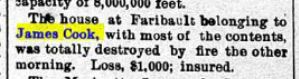
Searching for a James Cook in the Saint Paul newspapers isn’t easy due to the common name. The Minnesota Historical Society has digitized some newspapers from around the state. I did some checking for family mentions in those for Faribault but didn’t get a sense of when they moved. THEN I saw a Northfield News link. Northfield is in the same county. I may have found a reason they moved and why I have so little family memorabilia. I need to continue reading land records from Rice County.
Northfield News, 19 April 1890, Page 1, column 7. https://www.mnhs.org/newspapers/hub
Grandma also said Grandma Gert also said the family came from County Cork. Guess what county Dromcolliher borders? More research to do.
A recent press release from the National Endowment for the Humanities addresses part of what some colleagues and I were discussing today. The education component is vital.
The first two paragraphs of the announcement:
WASHINGTON, D.C. —Shelly C. Lowe (Navajo), Chair of the National Endowment for the Humanities (NEH), today announced a new NEH-wide initiative that draws upon the humanities to help Americans study, evaluate, and respond to some of the nation’s most urgent issues.
Today we face some of our greatest challenges as a country: among them, sustaining our democratic institutions, building a more just and equitable society, and preparing for and protecting our cultural inheritance from the effects of climate change. NEH’s new special initiative, American Tapestry: Weaving Together Past, Present, and Future, will leverage the humanities to strengthen our democracy, advance equity for all, and address our changing climate.
You know you need this! A New Webinar Membership with “24/7 access to 1,800+ full-length genealogy classes PLUS all 7,000+ pages of instructors’ handouts. Just $49.95 $24.98 (new memberships only).” Legacy Family Tree Webinars is offering this deal for new memberships from now through December 2, 2022 at 11:59 p.m. MT.
Maybe a Christmas, Hanukkah, birthday, or any day of the week gift for relatives and friends. Maybe you need to do some testing yourself. Order one today or tomorrow and get it before the holidays. It seems every company has something on sale. For example, MyHeritage is offering a 60% off sale. Free shipping if you order 2 or more. Maybe the reluctant aunt will test if she sees others getting the gift, too. Now, if all of you can convince more people in far eastern Germany to test, I will be extra appreciative.
Analysis, evaluation, correlation, and common sense are all words that need to be in our mind as we research our family’s history. Check dates, ages, time period, and years between events. On first glance, a record may be sensible. You found them! Look again at all columns or sections on a record and a conflict may show. Start writing a paragraph about each person to see some of the information that doesn’t jibe or is missing. Do you accept hints on genealogy websites without verifying the information? That’s one of the main ways that many online trees appear far off track.
A woman who had been deceased for ten years (you have the death certificate) would not have given birth to the 5-year-old child in the household on a 1900 U.S. census.
A man who had been deceased for five years would not have fathered the 8-year-old child shown on the 1880 U.S. census.
That daughter listed as a 16-year-old daughter on the 1881 Canadian census is likely not the daughter of the 25-year-old wife.
Check the birth states and countries for each person listed in a tree or on a household on a census. Let’s say the oldest child is born in Germany in 1862, the next child in 1865 in Pennsylvania, the third child in Alabama in 1866, the fourth in Italy in 1868 and the family is listed in Iowa on the 1870 U.S census. Might there be a problem with the listing? Do they all have the same two parents? Is one an orphan or a relative from a sibling of one of the parents? One online tree for a part of my family is as weird as this one.
The parents listed on a death certificate for a deceased person appear to make sense. It might fit the family story you were told. Who was the informant for the information? Did the father die in the Civil War, yet the informant grandson knows the exact names and birth states of his great grandparents when his grandma dies in 1926? It can happen, but further research needs to be done to assure you of the correct information. Don’t add them to the family tree quite yet.
You found Sam L. Griffin in the town where grandma said he was from. Several records from that county even tell that the middle initial L stands for Landon. It’s him, right? Wait, are you sure there aren’t other Sam or Samuel Griffins or Sam L. Griffins in the town or county? There are four. Ouch. You know “your” Sam was still alive in 1899 when he remarried so that would rule out the one who died in 1886. Your Sam was still in that town on the 1900 census with his second wife and five children that truly match both the family story and records. The Sam who moved to Canada from the U.S. about 1893 and was still there on the 1911 Canadian census is likely not in your family. A cousin, though? The fourth Samuel is still in the county on the 1900 cenand sus, but the wife and children do not match the other records that are pertinent to your own Sam and family. We need to compare people of the same name and even of a disparate age to be sure we have the correct person.
If it’s an online tree or one in a book, try asking the author what is the source of that “detail.” A polite question is fine, a demand for information is not. No response? Use that detail as a clue for further research.
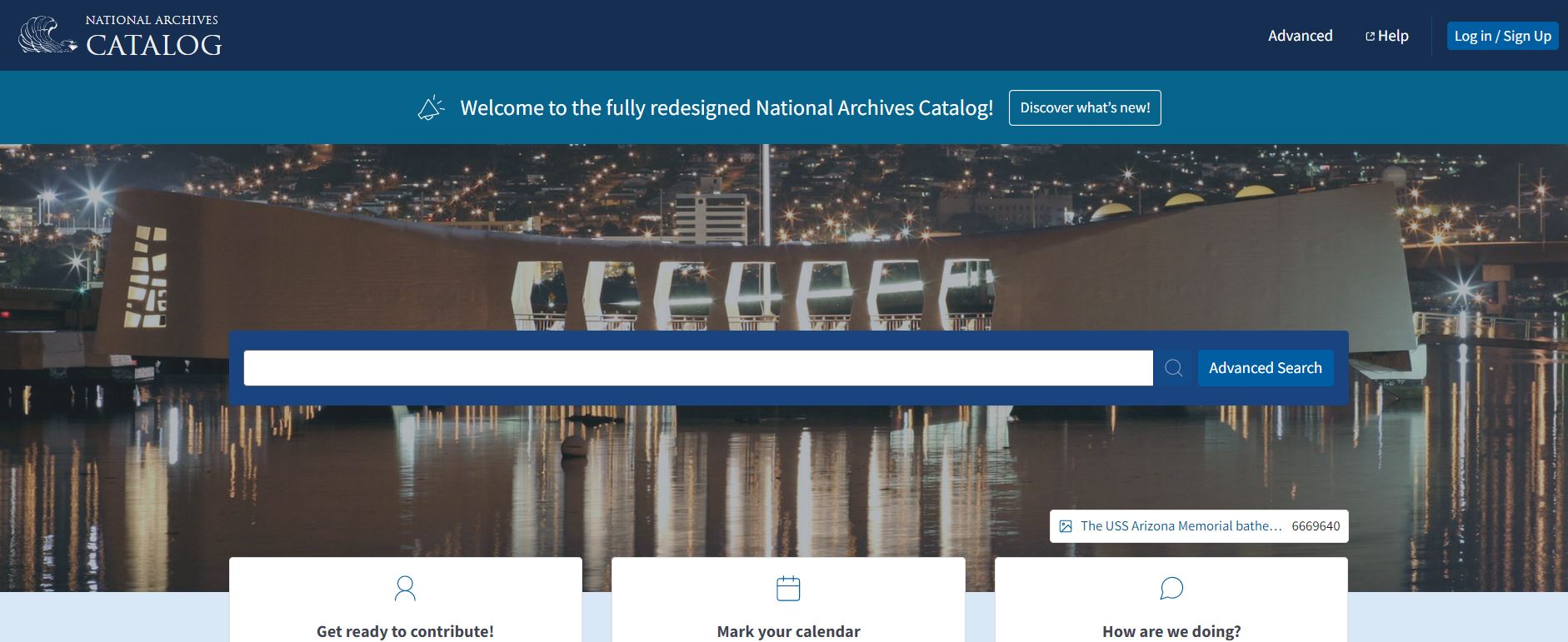
The official date is November 21st, but it’s live early. Lots of people doing presentations that include National Archives information and records are scrambling to update PowerPoint slides. Found something for my Native American research webinar on Monday night for the Kansas City Kansas Public Library. I even found a few things for my own research. Give it a try! I haven’t tried the advanced search yet. There will likely be official press releases on Monday, the 21st. https://catalog.archives.gov/
“History Organizations Across Minnesota Receive $4,987,373 in Legacy Amendment Funding” That headline in a press release a few days ago from the Minnesota Historical Society caught my interest. “
The Minnesota Historical Society (MNHS) is pleased to announce the newest recipients of 42 Minnesota Historical and Cultural Heritage Large Grants ($10,000 and more), totaling $4,987,373 in 23 counties.
Large grants are awarded annually to help nonprofits, educational organizations, government units and federally recognized tribes to preserve and share Minnesota history. This cycle of awards was approved by the Minnesota Historical Society’s Executive Council on October 27, 2022.
Minnesota Historical and Cultural Heritage Grants are made possible by the Legacy Amendment’s Arts and Cultural Heritage Fund through the vote of Minnesotans on Nov. 4, 2008. The Legacy Amendment supports efforts to preserve Minnesota land, water and legacy, including Minnesota history and cultural heritage.”
A few of the grant recipients:
Regents of the University of Minnesota (U of M Libraries), Minneapolis, $103,162 To provide better organization of the museum collections, allowing for greater public access to the community’s historic resources.
Stearns History Museum, St. Cloud, $120,342 To provide better organization of recent museum accessions, allowing for greater public access to the community’s historic resources.
Minnesota’s Black Community Project, Minneapolis, $25,000 To hire qualified consultants to research the history of Minnesota’s 21st century African American community, in preparation for a future documentary film.
City of Waconia, Waconia, $60,000 To hire a qualified conservator to restore a significant monument in the city’s collections.
Read the full press release with details on the grant funding background and for the full list of 42 recipients here: https://www.mnhs.org/media/news/17644

 inking about Christmas or Hanukkah gift ideas for family historians. What a change from even two to three decades ago. A box of blank CDs, a roll of film for a camera, or a few blank cassette tapes were great gifts. A paper gift certificate for membership in a genealogical or historical society was nice.