Halloween is time for free death records at MyHeritage

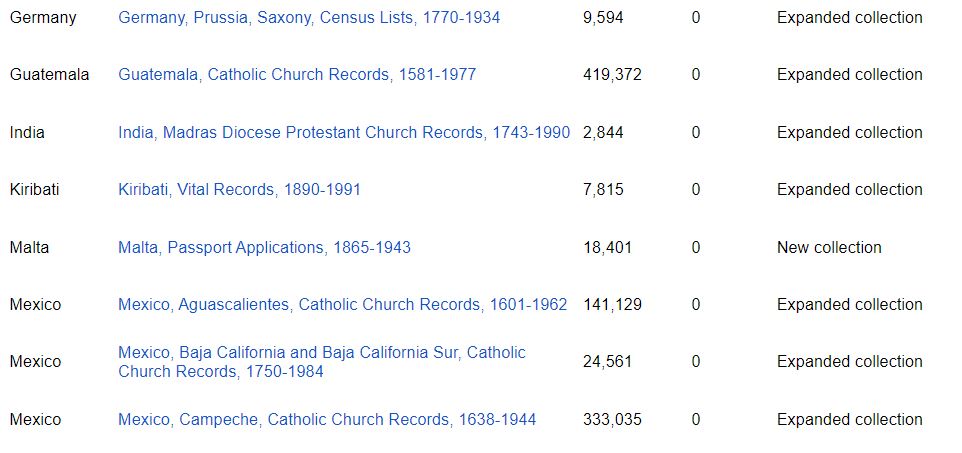
A bit morbid, but exciting for family historians! Daniel Horowitz at MyHeritage sent a Press Release for Halloween. He shared that the site is “opening up all the death records added to MyHeritage before October 2021 for free access during the week of Halloween, from October 27–November 2, 2021!” He also shared that since last Halloween, they “have added more than 37 million records to an already enormous collection of death records, burial records, cemetery records, and obituaries — bringing the total to 586,664,785 records. 11 collections were added or updated, including collections from Brazil, New Zealand, the United States, Poland, France, and more.”

Read more details on the MyHeritage blog. 9335_Free Death records image_753_463


The 1921 census of England and Wales is coming to us on January 6, 2022!

20th Century family in England and Wales? The 1921 census for those places will be released online at Findmypast in cooperation with the UK National Archives on January 6, 2022. Said to show 8.5 million households and 38 million people, this means lots of good researching. I will have to delve into it for the families of my own Copping line and for the Tresise and related lines of my grandchildren. Read more https://www.nationalarchives.gov.uk/ and https://www.findmypast.com/1921-census. How valuable is this? The Press Release I received from Findmypast includes: “What makes the 1921 Census even more vital is that it will be the last census release for England and Wales for 30 years, with the 1931 Census lost in a fire and the 1941 Census never taken.”

My friend, Audrey Collins, a Research Specialist employed by the UK National Archives, says “A more accurate title would be ‘Census of England & Wales, Isle of Man, Channel Islands, merchant vessels in the vicinity of England, Wales, Isle of Man and Channel Islands, Royal Navy, ships worldwide, and British Army and RAF bases overseas’.” Any surprise why a shortened title is used!


The 2022 Genealogical Research Institute of Pittsburgh

The Course Coordinators have signed their contracts and have been busy the last couple of weeks creating, updating, and finalizing our individual classes and courses for next June and July. The Instructors of the individual sessions have been working with us to be sure the titles and descriptions are accurate and, of course, tantalizing. For what? The 2022 virtual edition of the Genealogical Institute of Pittsburgh (GRIP)! It will be GRIP’s eleventh year!

I will be teaching in June and coordinating and teaching in July. The June dates are Sunday, June 19 to Friday, June 24. The July dates are Sunday, July 10 to Friday, July 15. Each week begins at 7:00 p.m. EDT on Sunday and ends at 12:45 p.m. EDT on Friday. Monday – Thursday are full days of classes, discussion, hands-on work, breaks, and even some light moments. Friday is a half-day. 

What are the course titles and what is being offered each week? We all need to wait for the dedicated GRIP Directors to assemble, finalize, and release all the info for both weeks. Deborah Lichtner Deal & Elissa Scalise Powell are going to be extra busy working on all this. The final details will be posted on social media and the GRIP website.

For now, put the dates on your calendar. Avoid dental, hair, car repair, and other appointments for those weeks. Warn family and friends, that those are YOUR weeks! For some info on GRIP review the website https://www.gripitt.org

https://www.gripitt.org/

Smart moves in genealogy: join genealogical and historical societies

To help celebrate National Archives Month and Family History Month, I have renewed some memberships in societies. At the top of my list are the Minnesota Genealogical Society (MGS, member 39 years) and the Minnesota Historical Society (member for 36? years). I’m also a member of other such organizations. with membership renewals spread throughout the year. If they all came due at once, my budget would tip over.  If you haven’t joined or renewed your membership, do it now. Publications, education discounts, access to databases, and helpful fellow family historians. These organizations are full of people with tips and who won’t necessarily run away when you mention the word genealogy. I am still close friends with people I met when I joined MGS. 

Reminder of discount on U.S. Government Records 101 and a special offer for genealogists

I think Family History Month should really be Family History Year or Every Year. If only more people would get involved in learning more about the research, records, analysis, and making sure that records back up what you think you know. I realized today that I don’t have the marriage date for my paternal grandparents. How did I miss that!

I am a big advocate of continuing education for genealogists. Until the end of 2021, I am offering a $15.00 discount on the cost for my course at Research Write Connect Academy. My Researching U.S. Government Records 101 is a four-session course that includes an extensive handout, suggested homework (you’ll be hooked) and special private Facebook group with chats, sharing, and updates. You will be invited to the Facebook page after you register for the course. 

Use Code PSW15 at https://www.researchwriteconnect.com/researching-u-s-government-records-101

Until the end of October, you may also receive a special freebie from Research Write Connect Academy. Details are at: https://www.researchwriteconnect.com/october-2021-31-days-family-history

Historic Minnesota statutes for genealogists and historians

We cannot do smart family history research without knowing what laws and related information govern the compilation and preservation of records. We need to understand the background of a record and why it differs by years and location. My friend and colleague, Debbie Mieszala, writes a series of blog posts to direct us to many of those laws that affect our research. Today, her post on The Advancing Genealogist, links us to historic statutes for the state of Minnesota. As she states, some states have website that pull many of these together and for other states, Debbie does in-depth research. Have some ancestral roots in Minnesota? Check out Debbie’s The Advancing Genealogist for more details. 

Oct. 11 Indigenous Peoples’ Day is for learning, honoring, and caring

Indigenous Peoples’ Day. October 11. It’s who I pay homage to today.  I am proud to say that my home city of Saint Paul and my home state of Minnesota have designated today as a day to celebrate this. The land on which I have lived all of my life belongs to those who first lived here. Likely you reside on similar land if you live in the U.S., Canada, or one of the many other countries originally inhabited by an Indigenous population. Population and People’s are terms which really don’t convey that I am talking about other human beings.

I have been fortunate that for many years, my genealogical and historical research and consulting business has been largely involved with various Indigenous tribes, bands, and communities in the United States. Reading original records in locations of the U.S. National Archives, state archives and historical societies, courthouses, and other repositories provided me with a history I never learned in school.

Tears have been shed as I read horrific comments made by ministers, storekeepers, Bureau of Indian Affairs (BIA) personnel, and others supposedly entrusted to look out for those under their supervision. Yes, supervision. The BIA and its predecessors deigned to anoint itself as the keepers of fellow human beings. Oh, let’s make the Indians become like white men. Let’s make sure they cut their hair, wear different clothing, refrain from special ceremonies, and no longer speak their language. It was also Congress and most Presidents that aided this.

Newspapers printed stories that were one-sided. Imagine that!

My own background does not include any Indigenous heritage. I do have ancestors from 8 other countries, and I am proud of that and that they were able to immigrate to the U.S. The mix of religious affiliations is mind-boggling. Like me, some with their proud Indigenous heritage have a mix of backgrounds, religions, and often, a mix of tribes. This has been a day for us all to think, care, and learn.


Indiana ancestors? New “Research Indiana Indexes” for searching family history!

A recent emailed press release from the Indiana Archives and Records Administration brought some exciting news. I found a couple items for which I need to research further. My children have ancestors in several counties including Greene, Crawford, and Dubois. Their lines moved to NW Arkansas.

“Research Indiana Indexes

Welcome to the Research Indiana Indexes, the new home of the Indiana Digital Archives. Thanks to the work of our staff and volunteers, over 1.36 million names are searchable online. More names and indexes will be added regularly.  Click here or on the image above to go to the Index page.

For privacy reasons, each index only includes records that are at least 75 years old. However, the Archives holds many more recent records. If you are looking for a more recent record, please send us an email and we will advise you of any consent forms that may be required. To learn more about the individual indexes, click here. These descriptions are also found at the bottom of each index entry.”

Maps and atlases from the former Minneapolis Municipal Library now at the University of Minnesota

A recent email newsletter from the University of Minnesota tells about acquiring a large map collection. I have toured and researched at the University’s John R. Borchert Map Library and it is an amazing collection. Additionally, the number of maps, atlases, and gazetteers that have been digitized is wonderful. This new collection is exciting!

The new collection is from the former Municipal Information Library that was in the Minneapolis City Hall’s clock tower and it was part of the former Minneapolis Library. The Minneapolis city library locations became part of the Hennepin County Library system and the city hall branch ended. Left behind were the maps and atlases among other records. 

Read Allison Campbell-Jensen’s detailed post about the fascinating process to save, transfer, and now the plans for digitization of this material on the University of Minnesota Libraries post “Rescue Operation.”

Then spend some time investigating the website of the Borchert Map Library. Heavily Minnesota but some for other states and countries. I loved the aerial view of the St. Paul area where I grew up. In 1945 it was pretty empty except for the Ford Plant. 

Maps from the Minneapolis City Hall clock tower


FamilySearch has completed digitization of millions of rolls of microfilm. Genealogists are happy!

In case you missed the news from FamilySearch that appeared a couple weeks ago, here is part of it:

“It is a milestone 83 years in the making. Today FamilySearch International announced the completion of a massive project to digitize its collection of millions of rolls of microfilm containing billions of family history records from around the world. The archive containing information on more than 11.5 billion individuals is now freely available to the public on FamilySearch.org.” A FamilySearch full press release is here

The records are from 200 countries and in 100 languages. The press releases have been a bit misleading because some of the actual digitized records are not yet available to the public due to contractural obligations with the entities that held the records which were microfilmed. Yet the wealth available to us is amazing. Not everything is indexed and won’t be for a longggg time. You can volunteer to help index records. Simply go to https://www.familysearch.org and click on the Indexing tab at the top. Can’t read most of those 100 languages? No problem, there are various indexing projects and lots of assistance.

Thank you FamilySearch!