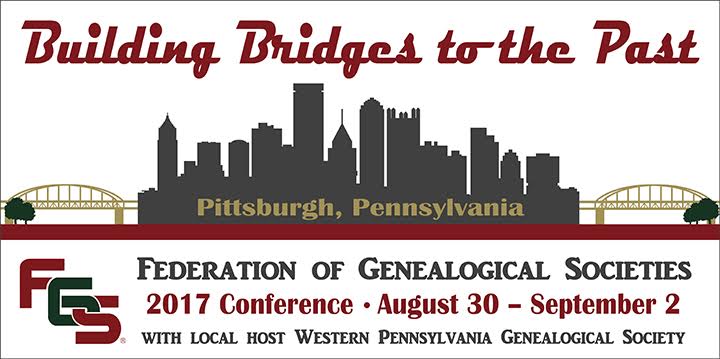
Registration is live today! FGS conferences are always full of education, shopping, and fun. I know I will see you there! The following is from today’s FGS Press Release.
Online registration is now open for the Federation of Genealogical Societies’ 2017 National Conference.
The conference will be held August 30 – September 2, at the David L. Lawrence Convention Center in Pittsburgh, PA. This year’s local host is the Western Pennsylvania Genealogical Society and the theme is “Building Bridges to the Past.” Register by July 1, 2017 for the early-bird discount at FGSConference.org.
Attendees can look forward to strengthening their research abilities no matter their skill level or area of interest. The program is available online at http://www.FGSConference.org. An 8-page pdf download is also available at http://fgs.org/upload/files/FGS2017-ProgramPreview.pdf.
Rorey Cathcart, FGS President, shares, “FGS Conferences offer genealogists of all skill levels an incredible learning opportunity as well as a chance to meet others who share their passion. Whether you are beginning your genealogy adventure or have been at it for decades, FGS welcomes all. With a day devoted to programming for society leaders and members, followed by three days of genealogy programming that features world-famous speakers, exciting workshops, a variety of special events and luncheons, FGS 2017 has something unique to interest all attendees. Don’t miss your chance to join the Federation for a fun-filled and informative experience in Pittsburgh!”
Conference Highlights
Keynote Speaker
Rick Sebak makes unusual television programs. His slightly wacky documentaries now celebrate various aspects of modern American life and the unexpected charms of Pittsburgh. In “Take the Unexpected Bridge,” he will explore the idea that when searching for information of any sort, from historic and genealogical to gastronomic and adventurous, often the best route is along unfamiliar roads and across unexpected bridges.
Conference Sessions
Learning opportunities abound in the FGS 2017 program. The program includes four full days of sessions, workshops, and interactive seminars. Learning tracks include Immigrant/Ethnic, Records, Regional, DNA, Methodology, Analysis, Skills, African American, Land & Taxes, Religion, Occupations, and more. Attendees of all skill levels will find new ways to uncover more about their family history.
Exhibit Hall
The large exhibit hall will feature the latest software, books, maps, databases, and gadgets on the market for family historians. Many genealogical organizations will be present to share information as well. Society Showcase will feature representatives of FGS Member Societies to share how their society can help attendees with their family history.
Special Events
Wednesday evening’s event is sponsored and hosted by Western Pennsylvania Genealogical Society. Registrants are invited to a dinner cruise along Pittsburgh’s three rivers on board the Gateway Clipper Princess. Friday and Saturday evening offer a special treat for baseball fans. FGS is partnering with the Pittsburgh Pirates to offer discounted tickets for games against the Cincinnati Reds.
Focus on Societies
Wednesday, August 30 is Focus on Societies Day. Sessions are jam-packed with ideas and tools to help societies promote themselves, develop projects, increase membership, and leverage technology. D. Joshua Taylor will kick off the day with the plenary session. He will discuss ways to package genealogical societies for non-genealogical partners, including local media, donors, charitable organizations, and politicians.
Librarians’ Day
Tuesday, August 29, is the pre-conference event sponsored by ProQuest. Librarians, archivists, and other information professionals won’t want to miss this event. It will be a full day of sessions focused on serving family history researchers.
Sponsors
Platinum sponsors include leading family history companies Ancestry.com, FamilySearch, and MyHeritage. Bronze sponsors include AncestryProGenealogists and Internet Genealogy/Your Genealogy Today. For the complete list of sponsors and partner organizations, visit https://www.fgsconference.org/exhibits/sponsors/.
Also visit the conference website at http://www.FGSConference.org for details including links to conference hotels, research opportunities, and more. Keep up with conference news and announcements by reading the FGS Voice blog at http://voice.fgs.org and by subscribing to the FGS Voice Newsletter at http://fgs.org/cpage.php?pt=71.
Learn More and Stay Connected
Like FGS at https://www.facebook.com/FGSgenealogy.
Follow FGS on Twitter at https://twitter.com/fgsgenealogy and hashtag #FGS2017.
Visit Pittsburgh at https://www.visitpittsburgh.com/.
About the Federation of Genealogical Societies (FGS)
The Federation of Genealogical Societies (FGS) was founded in 1976 and empowers the genealogical and family history community, especially its societies and organizations, by advocating for the preservation and access of records and providing resources that enable genealogical organizations to succeed in pursuing their missions. FGS helps genealogical societies and family history enthusiasts alike to strengthen and grow through online resources, FGS FORUM magazine, and through its annual national conference which provides four days of excellent learning opportunities for both societies and family history enthusiasts. To learn more about FGS visit fgs.org. To learn more about the next annual conference to be held in Springfield, Illinois, visit fgsconference.org. Also, find FGS on Facebook https://www.facebook.com/FGSgenealogy, on Twitter @FGSgenealogy and on the FGS Voice blog at http://voice.fgs.org.