Online Finding Aids from the Minnesota Historical Society

When is the last time you checked the wonderful online finding aids for many of the collections at the Minnesota Historical Society? Of course, there’s the library catalog, general descriptions of collections, and paragraphs describing various types of records, but have you seen the detailed inventories for others?

MHS has many in-house comprehensive finding aids but has been posting some on its website.

A few examples:

  • Thomas Scantlebury and Family: An Inventory of Their Papers
    U.S.-Dakota War reminiscences of a soldier in Company H of the Seventh Minnesota Infantry, accompanied by three diaries (1853-1857) and miscellaneous family information relating in part to the establishment of New Auburn (Sibley County), Minnesota.

Happy Birthday, Minnesota!

Why is it that some dates just stick in our minds? For me, one is the date of Minnesota statehood. On May 11, 1858 Minnesota became the 32nd state in the United States.

That’s 155 years ago. One of my great grandfathers, Michael Hanley, had already arrived in Minnesota Territory. He is on the 1857 census as a farmhand in Winona County. He later lived in the city of Winona. His brother is also listed but in a different household.

The annual history tour that I take with my three youngest grandchildren will include Winona this summer. The 11 year old asked to visit all the addresses where his ancestors resided. I will be doing just that at 478 Wilson Street in Winona. I will also tell them about the Hanley family.

Great genealogy events on my schedule and hopefully yours!

I am involved with several wonderful genealogy events that are taking place in the coming months. This means many registration deadlines. 

  •  May 14, 1:00 p.m., CDT, Friends of the National Archives – Southeast Region webinar. Join me from the comfort of your own home as I tell you about the wonderful things created by the WPA Historical Records Survey workers pre-WWII. You might be amazed at what they did for family historians. Register at www.friendsnas.org/webinarSch.htm
  • May 16, 7:00 p.m. St. Croix Valley Genealogical Society meeting at the public library in River Falls, Wisconsin. I will be presenting an interactive workshop on Research Planning. Pre-registration is not necessary. http://scvgs.wordpress.com/meetings/
  • June 7-9 is the 44th annual Southern California Genealogical Society Jamboree plus the pre-event Family History and DNA day on June 6th. Last day for pre-registration is Friday, May 24th. I am attending the DNA day and taking part in six presentations at Jamboree. www.genealogyjamboree.org/
  •  July 21-26 is the Genealogical Research Institute of Pittsburgh. Some courses are full but others do have a few spots left. I coordinate and teach in the “Intermediate Course: Tools for Digging Deeper” and teach in the “Bridging the 1780-1840 Gap: From New England to the Midwest.”Hurry! The Early Bird deadline is May 15th. www.gripitt.org
  • August 21-24, Federation of Genealogical Societies 2013 Conference in Fort Wayne Indiana. I am co-chair of this event and will be doing three presentations. Join a fantastic group of speakers and volunteers for a great week of genealogical learning, extended hours at The Genealogy Center of the library, some fun social activities, and networking galore plus a large Exhibit Hall. Early Bird deadline is July 1st. (save $50!) https://www.fgsconference.org/
     
  •  September 20-21, the first statewide New York Family History Conference sponsored by the New York Genealogical and Biographical Society. A great event near Syracuse, NY with many speakers, activities, and exhibits. www.nysfhc.org/index.html for details.

    “Five years later, Iowa still in need of state archivist”

    My news feed had that headline to an article this morning. The article states “Recent data compiled by the Council of State Archivists, a national organization of state records executives, indicates that Iowa ranks near the bottom of the nation’s 50 states in its commitment to state records preservation. In fact, Iowa is the only state in the nation without a state archivist and no pending action to fill the nearly five year vacancy.”

    I have researched at the state archives location in Des Moines and found it to be challenging. Equipment, finding aids, and records were all a challenge. Until recently the website lacked much as far as cataloging and is still far from helpful to people wishing to delve deeper into the history of Iowa and its people. I am sure it’s frustrating to the remaining staff who struggle to keep up.

    Hopefully those with the power to affect change will learn that the news is spreading and will work toward a solution. A great archivist and staff make all types of historical research so much easier. When I talk about Midwestern Research or about repositories of the Midwest, it’s difficult to include Iowa as there isn’t much that can be used for screen shots. Children with school assignments, news reporters, authors, genealogists, military researchers, history buffs, as well as Iowa history itself, need a leader to bring the state archives in Iowa up to snuff.

    Thankfully, there are many records filmed by the Family History Library and that provides a lot of help. Many local level courthouses and genealogical societies offer more help. 

    Read the entire article in the Press-Citizen.con.com here.

    Revisiting websites: Roselawn Cemetery, Roseville, MN

    The value of rechecking websites you have visited before has proven quite valuable to me in recent months. I visited Roselawn Cemetery here in Roseville, Minnesota back in the 1980s after learning that my paternal Stuart great grandparents were buried there. I have written and lectured before at the surprise that was there. Alexander and Emma (Slaker) Stuart are buried with no headstones. The surprise is because Alex’s occupation in Minnesota, Kansas, Illinois, and Wisconsin was that of a tombstone carver. A distant cousin told me he did exquisite work. On that visit I never asked who owned the burial plots because silly me just assumed that the husband owned them.

    My late night rechecking of cemetery websites to see what is new brought me to a burial index on the Roselawn website. I did a search for Stuart and found this:

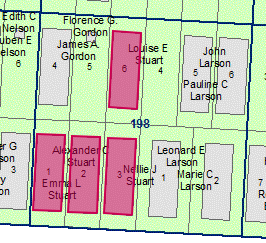
    Then I clicked and found this wonderful map showing the burials.The pink rectangles are the burials of Alex and Emma and their two adult unmarried daughters, Nellie and Louise. Imagine my surprise to see the names to the left of Louise. That is their another daughter, Florence, and her husband James A. Gordon. Checking them in the index I found that Emma owned their burial plots, too. Alexander had abandoned his family for many years. Family story has it that Emma was not easy to live with. Whatever the reason, Emma apparently was in charge of the finances. Now, where on earth did this woman get the money to purchase these spaces? Research finds always lead to more questions.

    The Harold and Hetty Stuart listed in the database are the son and daughter-in-law of Alex and Emma. Visit the Roselawn online records search here. http://www.roselawncemetery.com/

    Mocavo Announces Genealogy Karma

    I received this press release on Friday from Mocavo about a brand new volunteer effort.

    “Mocavo Announces Genealogy Karma

    Back in 1999, a fantastic resource was established to bring together members of the genealogy community all around the world. The brainchild of Bridgett and Doc Schneider, Random Acts of Genealogical Kindness (RAOGK) was created to help genealogists collaborate with the genealogy community to document their research, while also offering genealogists a way to give back to a community that had helped them in the past. RAOGK quickly turned into a global organization. The group’s volunteers were able to help thousands of genealogists make progress in their family history research.

    The ROAGK website went offline in 2011 because of a computer disaster. Sadly, Bridgett Schneider passed away later that year, and the website was never able to come back online. In tribute to Bridgett and Doc Schneider and all of the participants in RAOGK, many volunteers have created programs similar to ROAGK to help bring together the expertise of the genealogy community. Doc and Bridgett’s legacy and the efforts of thousands of volunteers inspired us to create a place for researchers to come together and collaborate to help other members of the genealogical community.  

    Today, at Mocavo, we are excited to announce the launch of Genealogy Karma. Modeled after Random Acts of Genealogical Kindness, we hope to empower the Mocavo community and connect researchers all around the country. If you’re looking for documents, records, or photos from an ancestor who lived far away, we will connect you with family history volunteers who can do this research for you in other cities. Likewise, if you’d like to give back to the Mocavo community and have a little time to donate, you can sign up as a volunteer.”

    To learn more and for directions, visit www.mocavo.com/karma

    Disclosure: Mocavo has provided me with access to Mocavo Plus.

    Genealogical Research Institute of Pittsburgh Savings Ends May 15th

    It doesn’t feel like May for some of us, but it truly is here. Are you thinking about attending the 2013 Genealogical Research Institute of Pittsburgh? It was a blast last year. We had fun in the dorms, in the cafeteria, and worked hard in the classrooms. The reviews after last July’s GRIP were fantastic!

    There are still a few spots left in some courses. The week begins late afternoon on Sunday, July 21st and ends at noon on Friday, July 26th.

    I coordinate and teach in Intermediate Genealogy: Tools for Digging Deeper.  In this course we have a lot of interaction and students have the opportunity to submit a problem of their own for discussion. Debbie Mieszala, CG, and D. Joshua Taylor, MA, MLS are the other instructors.

    I am also teaching in the Bridging the 1780-1840 Gap: From New England to the Midwest coordinated by Josh Taylor.

    Registration and payment no later than May 15th gives you a $35.00 savings. Check it out now at http://www.gripitt.org/

    One Billion mark for FamilySearch.org


    Can you believe it? A press release from FamilySearch on Monday announced a historic milestone. I am proud to have been a part of it.

    “Thank you for contributing to the billion! We did it! We reached a major milestone of one billion records indexed and arbitrated since the launch of FamilySearch indexing in September of 2006. We are grateful for the many volunteers who dedicate their time and efforts to make these records freely available for online research.

    Kenneth B. (California, United States), Brittney S. (Idaho, United States), and April R. (Alberta, Canada) were the lucky ones to index and arbitrate the billionth record! They will receive a FamilySearch backpack stuffed with FamilySearch goodies. We also want to thank all the volunteers who have contributed to the billion records with a FamilySearch indexing badge.

    It took us seven years to reach the first billion. How long do you think it will take us to reach the next billion? The advances of technology and the dedication of our volunteers have increased the speed in which we can process and deliver records for publication. Join the global effort to make the next billion records available for family history research. Start indexing now! familysearch.org/indexing”

    Have you helped with indexing records? It really isn’t difficult. Well, there are some tough to read records, but most aren’t that bad. You receive access to an easy-to-fill-in indexing form. I will be back to helping with the indexing next fall after I am finished with the work of co-chairing the 2013 FGS Conference. Anyone can contribute, we don’t need to be members of the Mormon Church. We all benefit.

    Summer Genealogy Institute in Pittsburgh

    Do you know about the Genealogical Research Institute of Pittsburgh? There’s something for everyone this year. Six courses, great instructors, and time for intense networking and even some fun. GRIP 2013 will commence in less than 100 days. It begins the evening of Sunday, July 21 and end at noon on Friday, July 26.

    There are still limited seats in a few courses. The early bird course deadline is May 15 by which time the tuition of $390 must be paid. Tuition is $425 thereafter. For those of you thinking about GRIP, now is the time to investigate further!

    The dorm is just steps away from the classrooms and cafeteria. Check out the courses and other details at www.GRIPITT.org

    “No longer saved for generations, family heirlooms are being shed”

    That is the title of an article in today’s online Star-Tribune. I know from my own experience that not all family members want to hang on to furniture, dishes, and other items.

    The sentences that really hit me are “Even highly personal items, such as scrapbooks, letters and photos, are now being shed. “We’re surprised,” Burley said. Empty the Nest sells those items to vintage dealers who buy in lots, turning mementos into artwork for others.” and “Mueller has purchased other personal items, including vintage diplomas and handwritten love letters, which she plans to use, along with vintage maps, to create retro decor.”

    These items that are then lost represent individual, family, community, church, and military history. The contents might help a family understand issues in the family dynamics. A letter from someone in the military might hold details that explain that person’s experience during a war or could even hold battle history that is found nowhere else. A mention of an illness might be a clue to hereditary health issues.

    The photos might include one of the christening dress that is still being worn by family infants today. A scrapbook might contain history of someone’s high school or college experience complete with programs from events, sports photos, graduation photos, and other items that the school archives is lacking. I wonder if any of the people disposing of such items has contacted a county or state historical society to see if any of these items might be appropriate for their collections? Have they contacted the distant cousins to see if anyone might like to have them? It’s easy to do that contacting via email and social media today.

    As someone in a family lacking much in the way of old scrapbooks, letters, and photos, this article was especially painful. Do historical societies, archives, special collections departments, and other institutions do enough public outreach about the value of such items? Do they let the public know how to preserve them and what items might be donated? I know a large part of that requires funds our institutions just don’t have  today.

    My pie-in-the-sky solution would be to have the funds and time to create a place to house such items. Then to catalog them all and have an online finding aid plus an index so that the information is available to family members and historians who might seek them out in the future.

    The full article is here http://www.startribune.com/lifestyle/homegarden/203862871.html