Breaking good news for now: Seattle National Archives

“SEATTLE (AP) — A federal judge granted a preliminary injunction Friday to stop the sale of the National Archives at Seattle. An agency has recommended the archives be shuttered in Seattle.

Washington state Attorney General Bob Ferguson’s office, along with 29 tribes and various groups, filed a lawsuit Jan. 4 seeking to declare the sale illegal. But that lawsuit could take a while to wind its way through the courts, prompting the request for the preliminary injunction. . .”

Read the full story at https://komonews.com/news/local/judge-blocks-sale-of-national-archives-in-seattle

Strategies for GRIP registration on February 17

Are you ready? Have you read the registration and courses pages on the Genealogical Research Institute of Pittsburgh’s website as I recommended 4 days ago? I’m asking that in my Mom voice.

The directors of GRIP have just released some Strategies for Registration. I strongly suggest reading that soon. (Mom voice again.)

Oral histories from the Iron Range area of Minnesota

Many news outlets are reporting this story. “The Erie Mining Company History Project Team, in conjunction with the St. Louis County Historical Society, is donating more than 150 oral history interviews to seven organizations in northeastern Minnesota.” Station WDIO in Duluth, Minnesota carried the story and the details can be read there.

The famed and storied Iron Range mining area of Northern Minnesota has been home to many immigrants. Other oral histories from the area can be found in various repositories in the state including the archives of the Iron Range Research Center in Chisholm, The Immigration History Research Center at the University of Minnesota in Minneapolis, and the Minnesota Historical Society in Saint Paul.

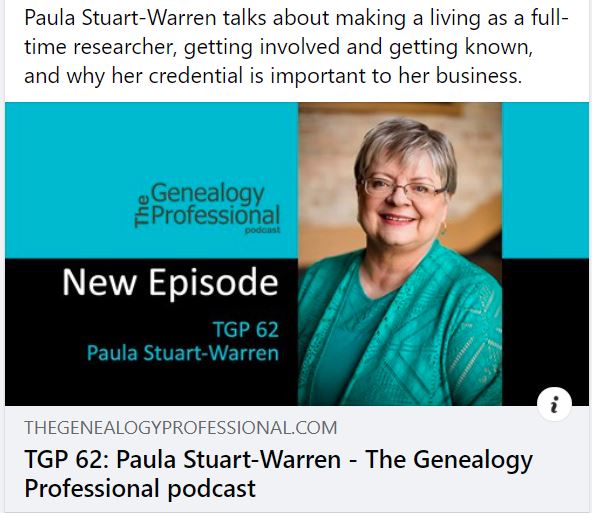
The Genealogy Professional Podcast #62: Paula Stuart-Warren

I’ve been interviewed on TV, radio, and for newspapers, magazines, blogs, conference publicity, institute publicity, and by family members for school projects. All were enjoyable parts of my professional genealogist career. A recent one sped by so fast because it was an extra enjoyable time. Marian Pierre-Louis’ interviewed and chatted with me for her The Genealogy Professional podcast. We veered off into many subjects related to what we both do. I hope you enjoy listening to us and learning a bit more about my career, activities in the field, volunteering, and other aspects I love about family history. https://www.thegenealogyprofessional.com/paula-stuart-warren/

Only 15 days till Genealogical Research Institute of Pittsburgh registration opens

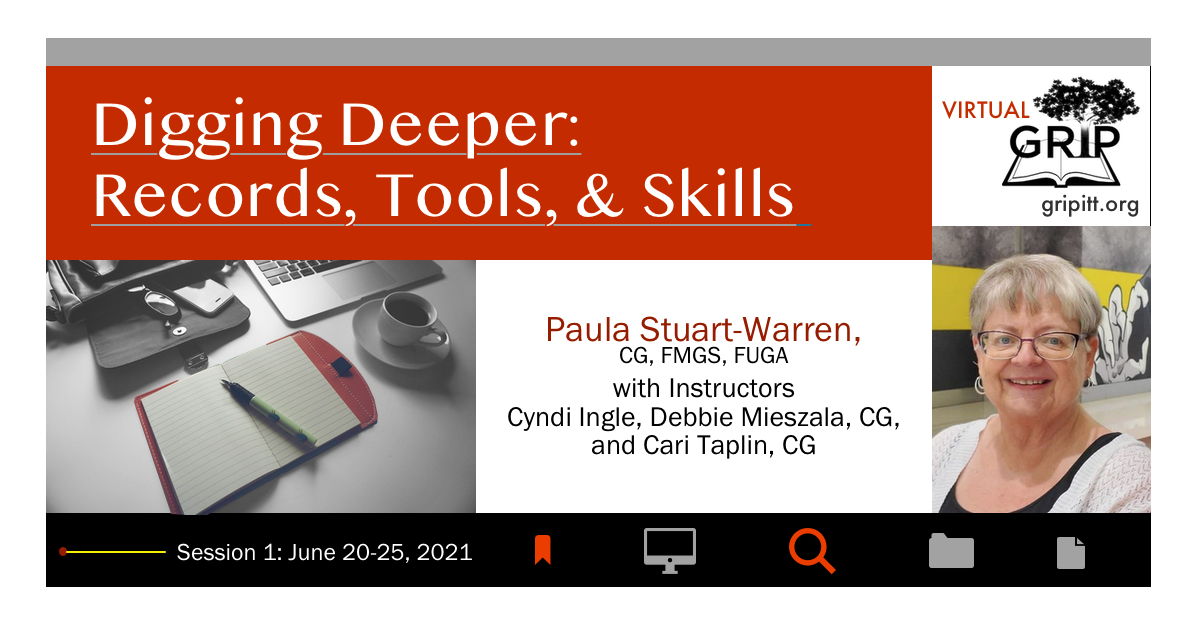
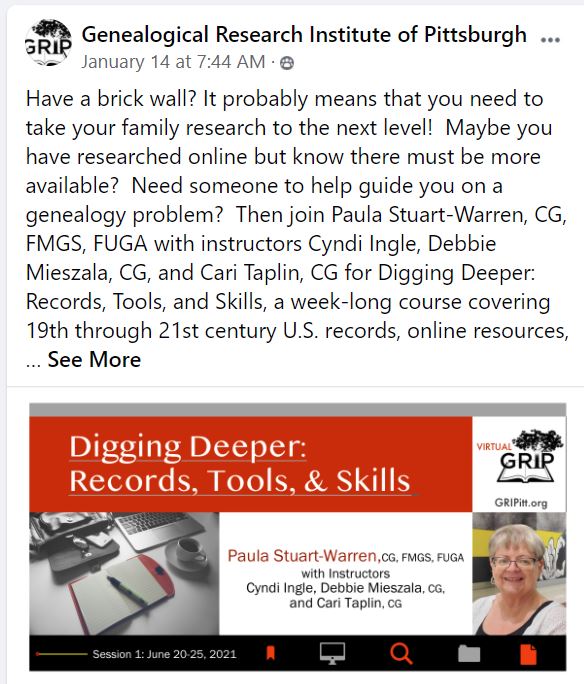
A full week of in-depth education. Are you ready? Have you read all the registration details? Have you chosen a course? Wednesday, February 17th is the online registration date. The course shown below is being held June 20-25 and it’s going to be online the entire week. The syllabus for this course is extensive and the instructors are engaging, knowledgeable, and experienced. Please join us in June! https://www.gripitt.org/courses/digging_deeper/

Donating family history, china, bibles and more needs planning.

The treasures found in historical societies, libraries, archives, museums, and other repositories are never-ending. We already know that there is no one place that’s best for all of our family history or community research. Today, online catalogs, finding aids, and photos help us locate items related to a family or locality. One of the frequent questions I receive is “where should I donate my” bible, candlesticks, research files, farm equipment, or other items. I have a several pronged response:

  1. Donate to a place that has good cataloging and an online presence so that others may find your cool stuff.
  2. Be sure that place is run by caring staff and that it has the proper temperature-controlled storage.
  3. Donate to a place that relates to the material. If you family research is largely connected to Iowa, don’t give it to a place in Oregon. If the candlesticks are truly unique and were initially used in Indiana, do they really belong in a museum in Texas?
  4. Don’t drop off your box or boxes of material without first checking to see if the repository really wants your items.
  5. If that place is ready to accept your boxes, be sure to follow their instructions as far as arranging, appointment time, descriptions of what you are donating, and anything else that is required. Sometimes, funding is requested to rebind books or to arrange a collection or to create a finding aid.

A recent article in the West Central Tribune published in Willmar, Minnesota, was titled “West central Minnesota museums struggle with too much of a good thing.” It’s worth a read and explains some of the issues facing our historical societies, archives, and museums. I’m guessing many of us have been sorting things around our house, attic, and basement and are thinking of donating items. We really do need to think before we even contact the place.
Genealogy webinar travel virtually

I was updating my general and my webinar calendar and thought about all the places I would “travel” to in the coming months. Today’s ability to present genealogy education via online platforms has definitely enhanced the ways in which we can stay educated, up-to-date, and interact with each other.

Photo by Juliana Kozoski on Unsplash

I thought about the places for which I am presenting and I will be “in” Pittsburgh, PA, Madison, WI, Warner Robins, GA, Monmouth, NJ, and here in Minnesota. Then I thought about all the places from which registrants will be attending. That is a never-ending list!

Follow me around the world here: https://genealogybypaula.com/speaking/speaking-calendar/


Feb 17 — Register for GRIP genealogy excellence online

Only a month until online registration opens for the 2021 weeks of the Genealogical Research Institute of Pittsburgh (GRIP). It’s the tenth year and I have been with GRIP for all 10 years! So many courses from which to choose over the week in June and the week in July. It’s VIRTUAL in 2021 and the virtual edition in 2020 was easy, fun, interactive, and received rave reviews. Get ready to register on February 17th!

This is the cool new image for the course I coordinate and that will be held June 20-25. We will definitely be digging deeper and sessions are being updated and some new ones added. It’s an interactive, research assistance, self-study, and more week. See the topics and descriptions here.

I will also be presenting three brand new sessions in the course The Spirit of the Inland Seas: Research in the Great Lakes Region. I have been involved in Great Lakes states and provinces research for many years.


Applications for BCG’s Paul Edward Sluby Sr. African American Scholarship

Details from a BCG Press Release on this unique opportunity for African American genealogists!

Applications for scholarships for African Americans to participate in national genealogical institutes are due 15 March 2021, the Board for Certification of Genealogists® (BCG) announced today. This scholarship, established in 2020, is named after the first board-certified African American genealogist, Paul Edward Sluby Sr.
 
Scholarships will be awarded to up to three students who are African American, to cover up to $1,700 of the tuition, travel, and lodging expense of attending one of five premier national institutes. BCG will also waive its final application fee of $300 for scholarship recipients who submit portfolios of work to be considered for certification within three years of the announcement of an award.
 
The application form and supporting material is posted on BCG’s website at www.bcgcertification.org/african-american-scholarship. Applicants are required to submit an essay and a sample of their genealogical research. It is anticipated that scholarship recipients will be awarded in May 2021, so that recipients can take part in institutes scheduled for 2022. Those wishing to apply should fill out the required application form and submit with supporting materials to [email protected].
 
The five institutes eligible for scholarships for tuition, travel, and lodging expenses (where applicable) are:

(more…)