5 days free to Findmypast British and Irish collections
Five days free! Findmypast is giving researchers free access to most of the British and Irish collection from 22-26 June.
FREE access to British & Irish records between 22-26 June.
Five days free! Findmypast is giving researchers free access to most of the British and Irish collection from 22-26 June.
FREE access to British & Irish records between 22-26 June.
I saw reference to this in several places today. Yet another upcoming resource for digitized newspapers and other materials. This is a bit different in that it will include many newspapers from outside the U.S. The company involved, East View Information Services, is located here in the Twin Cities area of Minnesota.
From the press release last year:
“Minneapolis, MN, USA. November 2, 2016—East View is excited to announce a long-term relationship with Stanford University Libraries and the Hoover Institution Library & Archives to make rare newspapers from around the world available for research. East View will work with faculty and collection development specialists in numerous subject areas to improve discoverability and access to over 2,500 predominantly foreign-language titles dating as far back as the nineteenth century that are part of the collections at Stanford Libraries and the Hoover Institution Library & Archives.
Opening a treasure trove for researchers, this joint initiative will digitally preserve and make searchable potentially 25 million pages of newspaper content originally collected by Hoover curators and later cataloged, organized, and stored at an offsite facility by Stanford University Libraries.”
This company deals with a variety of countries and more information on this newspaper initiative and other material is available here: eastview.com/pressreleases/rarenewspaperspr
Deadline June 20, 2017
Named in honor of Jimmy B. Parker, whose legacy of service to the genealogical community covered more than 50 years, this full-tuition scholarship will be awarded to an individual who has “demonstrated commitment to genealogical excellence and community involvement”. The winner will be announced July 1st and their course of choice pre-reserved. Full details here.
Deadline June 20, 2017
This fund, opened at SLIG 2016, was created to enhance scholarship opportunities for SLIG students. Donations have been made by Maia’s Bookstore and SLIG students. More details and submission requirements may be found here.
This award provides “financial assistance for a developing scholar to attend one of five academic programs in American genealogy.” The award, which will be given in October, will apply toward a SLIG 2018 course of study. To find out more, visit their website.
Deadline TBD for SLIG 2019
Established to “foster and support professional genealogists in their ongoing development efforts”. Scholarship covers tuition and specific other expenses to attend one of the four US-based genealogical institutes.
Unfortunately, due to a lot of complicating factors, applicants won’t be aware of the courses to be offered for SLIG 2019 until after they have completed their application. For that reason, we offer the opportunity to have open dialogue with the director if needed to help you rank SLIG in order of attendance preference on your application.
You can learn more about the AncestryProGenealogists Scholarship on their website.
p.s. The SLIG Course I coordinate is Taking Your Research to the Next Level. The SLIG 2018 dates are January 21-25. Registration opens on July 8th. Get your fingers ready to log in on that date!
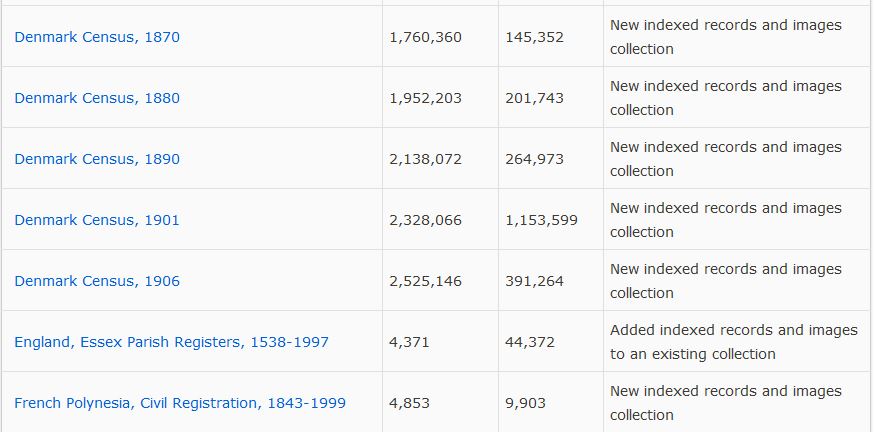
Findmypast added a bunch of items this week. Two jumped out at me.
One is actually two, the 1881 and 1891 Canadian censuses. My guy still doesn’t appear but the collateral lines do. (Copping, Reinhart, Jones, and others).
Canadian searches have been separated from the United States and that makes me happy!
The Essex Burial Index covers 1530-1950 but does not include all burying grounds. But, it still gave me 18 Copping burials to investigate. My branch left Essex for London and then ended up in Canada so I need to figure how these others connect.
Read the site’s blog to see what else has been added.
The Legacy Family Tree webinar I did on Wednesday, June 7, is now online for free until the 14th.
I enjoyed presenting Researching Your Minnesota Ancestors. From the evaluations, it’s apparent I have convinced many people they need to come to Minnesota for research and tourism. For some who live here already, new resources were learned. A 5 page handout accompanies the webinar.
Can’t get to it by the 14th? Please consider a subscription to enjoy the vast library of webinars.
Click here to view the video.
I promised a few people I would share a packing list for this summer’s GRIP. I am teaching the week of July 16-21 in my intermediate level course. People seem to know that I like to be prepared for just about anything. Of course, your packing list will differ depending on whether you fly or drive. These are in no particular order and are directed at those staying in the dorms. A dorm is a dorm, not a 5 star hotel. I have stayed in a dorm room every year at GRIP. If you have other suggestions, please add them in a comment.
This afternoon I set aside a couple hours for my own research. I rechecked a specific database on Ancestry.com, U.S. Passport Applications, 1795-1925.
Once again, I searched all my ancestral and collateral surnames from that time period. Whose passport did I find? Nobody’s. Zilch. Nada. Nothing. Nil. Zero. I know that passports were not required during those years, but even individuals in the family who were traveling outside the U. S. during those years did not appear.
I switched the search to some of my niece’s ancestors and up popped the surprise, a passport for her Great Great Great Grandfather Theodorus B. Dubois. He stated that he was born in New York City on 11 February 1822. He applied for the passport on 6 April 1870. The year of birth matches other records. His signature is easy to read!
He was a ship’s captain and traveled all over the world. He had service in the U.S. Navy during the Civil War. His widow’s pension is on Fold3.com. The details that record holds are voluminous including much on his widow’s (Elizabeth Marfing) family.
At the bottom of the passport application is a physical description of Captain DuBois. He was 5’5″ tall, had brown eyes and dark brown hair and a beard but no color was listed for that. He had a full face, thick nose, high forehead, and a florid complexion.
The amount of information found for this man continues to amaze me. He was 6 when his father died (Thomas Koert DuBois) and 14 when his mother died (Sarah Ann Corwin). A descendant has done DNA testing and now we await the results.
June 2, 2007 was the first time I posted on my own blog. How can ten years have passed so quickly? I checked my mail today and looked for a package outside my apartment door but apparently everyone forgot to send me diamonds for the tenth anniversary!
I had begun blogging earlier than that as the editor of the long-running FGS Conference Blog (Federation of Genealogical Societies).
There have been many ups and downs in my life in those ten years, days when the words for a post did not come to mind, and many other days when I had wonderful things to share. I have no plans to quit.
Thank you to my readers. Your support keeps me going. I don’t need the diamonds. I need my family, my genealogy colleagues, and my computer!
I already have a post planned for this weekend. A new discovery!
Sanborn Fire Insurance Maps are a great resource to learn more about the building in which your family lived or worked. Today, the Library of Congress announced that it is placing more online. This means free access. You might have already found some Sanborn maps accessible via a library or historical society website or on microfilm at one of these. Now, this collection will pull them all together electronically in one place when it is finished.
The maps cover about 12,000 towns and cities. They show an outline of each building and where the windows and doors are locates. Because these maps were created for insurance purposes, the maps show the property boundaries, if the is a fire wall, where the rail lines existed, street names, and what material was used in the construction of the building. You’ll learn about the nearest fire hydrant, whether the home or other building is brick or wood and what type of roofing it has. Gas lines are show. The maps cover various years from the mid 19th Century to the mid 20th Century. It’s a good way to learn more about a building that no longer stands.
For the full press release on the LOC website, click here. The image below is from the LOC posting on Facebook.