2016 Southern California Genealogical Society Jamboree News!

Here’s a fantastic press release. I am honored to be one of the speakers.

January 1, 2016 – Burbank, CA – The Southern California Genealogical Society is pleased to announce the 47th Annual Southern California Genealogy Jamboree. The conference will be held at the Los Angeles Marriott Burbank Airport Hotel, Burbank, California, Friday through Sunday, June 3-5, 2016.

Registration is now open and available on the Jamboree website at http://genealogyjamboree.com/.

Jamboree 2016 offers an exceptional educational opportunity for family historians and genealogists of all experience levels. The theme for Jamboree 2016 is “Giving to the Future by Preserving the Past.” We welcome all attendees who are interested genealogy and preserving the past for future generations. Our heritage focus is on German, Eastern European and African-American research. Topics covered include research methods, analysis and problem solving, organization techniques, family history writing, the use of technology, and more.

Jamboree 2016 will feature:

  • Over 55 national, regional and local speakers
  • JamboFREE sessions Friday morning including Beginning Genealogy, Librarians’ Boot Camp, Why and How to Become a Professional Genealogist, Using Social Media for Genealogy, and Genealogy & DNA Roundtables
  • Five specialty workshops (separate fee required)
  • Free exhibit hall throughout the weekend
  • Research tours Thursday and Friday
  • Special activities each day
  • One-on-one research assistance provided by members of the Southern California Chapter Association of Professional Genealogists and other APG members

Back by popular demand, SCGS will hold its fourth Genetic Genealogy Conference, “The Future of the Past: Genetic Genealogy 2016,” on Thursday, June 2, 2016, also at the Los Angeles Marriott Burbank Airport Hotel. This conference provides the opportunity to hear from some of the top leaders in the field of genetic genealogy, with topics suitable for all levels of experience with using DNA for genealogical research. Six intensive workshops will also be offered during this event that will provide an opportunity for in-depth study of genealogical research techniques of interest to a variety of experience levels (additional fee required). The Genetic Genealogy Conference is separate from Jamboree, and separate registration fees apply.

Early Bird registration ends April 23, 2016. Special pricing for 2016 offers a discount to those who register for both Jamboree and “The Future of the Past: Genetic Genealogy 2016” as well as discounts for SCGS members for each event.

Don’t forget to make your hotel reservations! The Los Angeles Marriott Burbank Airport Hotel room reservations are now open. Room rates range from $165 to $185 per night. To make your reservations online, visit http://www.tinyurl.com/jambo2016Hotel/, or call directly at 800.736.9712. Be sure to mention the group “SCGS Conference” when making your reservation to get the Jamboree rate and to guarantee your room.

The best way to keep in touch with Jamboree and the Genetic Genealogy conference is to subscribe to the Jamboree blog, http://www.genealogyjamboree.blogspot.com/, either through RSS feed or by updates sent directly to your email. Information on Jamboree activities and schedule details will be updated regularly on the Jamboree website http://www.genealogyjamboree.com/.
Identifying Past Minnesota Photographers

Hidden in that old trunk is a photo with a name on the frame showing a Minnesota photographer. Now you have to figure out more about the photographer and where the photo may have been taken.  The Minnesota Historical Society has several resources to help you on this search. Click here for that info.

Before using those resources, you might want to check out the online Directory of Minnesota Photographers.  This directory allows searches by the name of the photographer and also the names of galleries and studios. Use your browsers search or find button to search by a place name on the galleries and studios page.

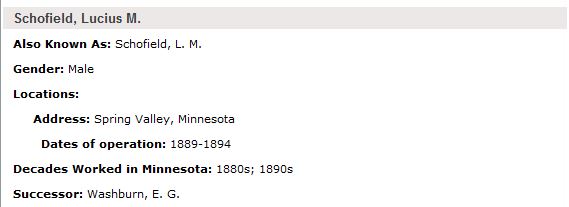
This is an example of a search result when searching by a photographer’s name:

photographer by name


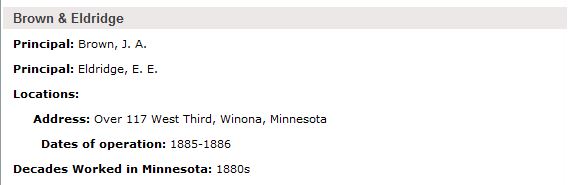
This is an example of a search by studio name. photography studio


Gen-Fed: Genealogical Institute on Federal Records

The following paragraphs are from a press release yesterday. I attended this institute a bunch of years ago and strongly recommend it.

Researchers entrance on Pennsylvania Ave.“The Board of Trustees of the National Institute on Genealogical Research has announced that the institute’s name was changed to the Genealogical Institute on Federal Records (Gen-Fed) on December 22, 2015. The institute, held annually at the National Archives in Washington, D.C., was founded in 1960 as a three-week general course on genealogy. In 1987, it narrowed its focus to federal records.

The institute was incorporated in 1989 as a non-profit 501(c) (3) organization. Trustees are representatives of the American Society of Genealogists, Association of Professional Genealogists, Board for Certification of Genealogists, Federation of Genealogical Societies, National Genealogical Society, and the institute’s alumni association. The National Archives, a non-voting member, provides strong support.

“Given the growth in genealogical education, it made sense to choose a name that clearly identifies the institute’s mission,” said Malissa Ruffner, JD, CG, director. “A new website, www.gen-fed.org, offers a closer look at the program, which is scheduled for July 11–15, 2016.  You can also follow the institute on Facebook and Twitter (@GenFedInstitute).”

Diane Dimkoff, coordinator of research customer support at the National Archives, stated, “We are pleased that the institute’s new name reflects the significance of federal records and look forward to continuing our traditional collaboration.”

Gen-Fed is for experienced genealogists, and for archivists, historians and librarians interested in using federal records for genealogical research. It is designed to instill a methodological framework and foster creative thinking about relevant records. Online registration for the 2016 session will be held in late February.”

Getting ready for a trip to SLIG and the FHL

It’s a January ritual for me and this year about 350 other people. This includes people from all over the U.S., Canada, and some other countries. The week-long Salt Lake Institute of Genealogy (SLIG) begins on Monday, January 11th with a special reception and registration the night before. That’s when students pick up their syllabus for each course.

Some arrive before SLIG in order to research at the Family History Library (FHL) where it’s a joy to simply pull films out of a drawer rather than waiting for them to arrive in your home area. Yes, some students live in the greater Salt Lake City area, but often the duties of daily life interfere with getting downtown to do the research. Others stay after SLIG and many scurry over to the FHL after classes each day.

As many of you know, I coordinate and teach the intermediate level U.S. Records and Research course that is a great step to take before some of the advanced courses. In this course, visits to the library are a must as students work on the week’s class project which is the main homework. The students in this course also have an opportunity to sign up for a private consultation with me or the other two instructors, Debbie Mieszala, CG, and Josh Taylor, MA, MLIS.

In addition to preparing for SLIG, I am reviewing client files to see what must be accomplished at the FHL and also some of my own files for a bit of family research. I have a few new leads on my own family. This means I am listing films that I want to view while I am there and can easily move from a filmed index to a filmed record or move to another film when I make a great discovery. Bring along a couple flash drives so that you can make digitized images from the films and transfer to your own flash drive. The flash drive is also important if you find something online while using one of the many library computers and subscription databases.

Don’t forget to pack a power strip/surge protector! We all have many things to plug into one.

I bring along some granola bars and apples for quick breakfasts and daytime snacks.  A Harmon’s grocery store is about 3.5-4 blocks from the Hilton Hotel where SLIG is held. Another option is to take the Trax light rail down to 400 South at 600 east to Smiths. Smiths has much more than groceries including clothes, jewelry, and even tools should you need a wrench for some reason! My main reason for going to the grocery store is to get lots of water and fresh fruit. The FHL allows us to bring in a closed water container.

My packing list includes plenty of lip balm and lotion since the air is so dry there. I bring my computer, cords, and my Fopydo for taking pictures from books using my phone. What is a Fopydo? www.fopydo.com/ You will likely see a few of us using one when we are on the third floor of the library.

One of the most important things to bring if you will be using your own computer in the library, is a cable lock that can help protect this important possession.

Light sleeper? Bring earplugs and a eye mask. Good sleep makes a better learner and researcher. The rest of what you need to bring is the standard stuff for any trip. If you don’t have a packing list, start one now and check online for lists others have posted on websites. It’s terrible to waste FHL time by running to the store again to purchase something you forgot to pack.


Alexandria, Minnesota resident traces family history to Silent Night composer

Silent Night is a song that I have sung for most of my lifetime. In church choir we sang it and our family sang it at home.  The Alexandria, Minnesota Echo Press has the story of Butch Dallmann of Alexandria who “grew up hearing stories about his great-great-great-grandfather, an Austrian organist and choir master named Franz Gruber.”

Dallmann visited the composer’s Austrian village of Oberndorf in 2002. What an experience that must have been! The full story by writer Jessica Sly is worth reading in the Echo Press.

Update: Be sure to read Doug Williams’ comment to my post. Doug knows music and genealogy.


Updated Genealogy Presentation Calendar for 2016

I just finished updating my calendar of speaking engagements for 2016. These presentations will bring me in-person to many parts of the U.S. and to more in the U.S. and worldwide via some webinars. I hope you will join me at one or more of these and, as always, be sure to bring your questions.

The list of these presentations for 2016 is here.  I do still have open dates if your organization is in need of a speaker. Check under the Speaking tab on this page to see a list of my topics and more on my background in genealogy and history. I have been updating many of these and most will be tailored to include information related to the area in which they are presented.

Counties losing support for historical societies shows a lack of understanding

Today’s Star-Tribune in the Twin Cities carried an interesting article. Interesting but sad and covering something that occurs too frequently in many places. The article “As counties tighten their belts, local historical societies hold their breath” told the story of some Minnesota county historical societies that have lost support funding from county commissioners.

One section of the story told what is too often the case. Brent Peterson, Executive Director of the Washington County Historical Society [and former member of the Board of Directors of the Minnesota Genealogical Society], discussed the county’s loss of funding for the reason that “history was not a “core function of government” . . . “I actually asked the county attorney one day what a ‘core function’ is, and he laughed at me,” Peterson said. “He goes, ‘Whatever three of the five [commissioners] say is a core function.’?”

My response is that I have had to use historical records in more than one county to help one county gain clear title to the land on which its courthouse sat. In another case, I have used multiple counties’ records to help clear title to some right of way lands in a county. I have used the records from counties in several states in work for federal lawsuits. Other county and state level records of historical value are needed for many other personal, legal, and community reasons. The papers of those who helped create and settle our counties and states are needed in much research. The same goes for the papers of businesses

Gee, not in that set of core functions of government! I could give more examples but I will spare you the list. Talk to your county and town commissioners, supervisors, and state legislators. Heck, don’t forget your national legislators. The National Archives needs continued funding to help preserve this country’s historical records.

Additionally, these historical societies and archives bring researchers lodging, food, and other dollars to the community. I am in the midst of a week-long research trip to Wisconsin. I will have researched in 3 counties and we are enjoying both state and county level historical societies. Our credit cards are being used, too.

Read the full article here.

Recent accessions with a genealogy connection. Recent what?

New-Sign--Arvin61r58-300pxAccessions? What is she talking about! I am talking about manuscripts, photos, books, maps, and other items recently or newly donated to or purchased by our great research repositories. These could be the county or state historical society, ethnic society, state archives, university special collections department or any other place we may go to do research. I am not talking about online databases and websites in this post. Why do you need to be aware of these recent accessions or acquisitions? Holy cow, simply because something might be related to or about your family.

Some repositories list recent accessions in their newsletters, blogs, or other publications, others on their website, or both. These are usually records that we aren’t going to see indexed or digitized online for a good long time. Listed below are some that I found on repository websites. I bet some research on your part will find collections you will be itching to get your hands on! Read the blogs, newsletters, and Facebook pages of such institutions on a regular basis. Do some online searching using the terms accessions, acquisitions, new, what’s new, recent and the name of a place or simply “historical society acquisitions”  or accessions. Listings from years past also serve to let us know what research gems these places hold.

  • Virginia Historical Society: Account book, 1858–66, of William D. Tucker (of Amherst County) concerning agricultural activities and financial affairs, along with records of marriages and deaths of neighbors and lists of enslaved persons. [186] p.: holograph; 12 x 7 1/2 in. Bound volume. Gift of Deborah Lumpkin Ferrell in the name of the Lumpkin family.
  • Minnesota State Archives: Waseca County. Docket (dated 1858-1868), registers of civil action (dated 1858-1944), defendant and plaintiff indexes (dated circa 1858-1939), index to marriage records [circa 1857-?], veterinary license record (dated 1937-1981), index to coroner’s certificates (dated 1955-1990) and coroner’s inquest file no. 205 (dated 1968) of the District Court; will books (dated 1972-1981) of the Probate Court; selective service record (dated 1941-1946) of the Selective Service Board; civil dockets (dated 1953-1974) of the City of Waseca Municipal Court. 17 boxes.
  • LancsterHistory.org: [PA] Slaugh family and furniture business records, 1880s-1953 Ledgers and records of the furniture business, 10 volumes. Letterhead of Henry Slaugh and billhead of Slaugh and Son. Photographs of Henry Slaugh, Sr. and Clara Slaugh; Dr. Joseph Houston. Gift of Nancy Slaugh Leech Mohr and Helena Louise Slaugh Freeburg, in memory of the Slaugh family MG-733,
  • Cornell University Rare & Manuscript Collections: On June 15, 2004 the Huntington Free Library’s American Indian Collection, located in the Bronx, NY, transferred its holdings to Cornell University Library. The Huntington collection, appraised at $8.3 million in 2001, contains more than 40,000 volumes on the archaeology, ethnology, and history of the native peoples of the Americas. The Huntington Free Library contains spectacular treasures that will provide students and scholars with a rich resource for the study of Native American cultures. Collection highlights include early printed books on travel and exploration containing accounts of encounters with native peoples; rare dictionaries of native American languages; an album of original drawings of American Indians by the artist George Catlin; field notes by 19th century ethnographers and papers of archaeological expeditions; an original manuscript peace treaty between the Delaware Nation and Johnson Hall; the Stockbridge Indian papers; the Joseph Keppler Iroquois Papers; and the papers of the Women’s National Indian Association.


Free webinar Wednesday, December 2 about the U.S. National Archives

 One of the joys of research is touching the original records of our ancestral families. I have done this and also worked on microfilms of some records many times onsite at the U.S. National Archives locations in Washington, DC, College Park, MD, Boston, MA, Chicago, IL, Kansas City, MO, Denver, CO, San Francisco, CA, and Seattle, WA. No two locations are alike in many ways, but a big similarity is that they all have records just waiting for our family history searches.

Want to know more? Join me when I present a FREE Minnesota Genealogical Society webinar on Wednesday, December 2. “The U.S. National Archives: The Nation’s Attic” 7:00 pm to 8:15 pm, Central Time. http://goo.gl/3AnWXU

The webinar is FREE to everyone that night. After that, it will be on the MGS website for members only. If you are already a MGS members, you know about the lineup of webinars. Join now to gain access to the archived ones presented by experts from the U. S. and Canada.  www.mngs.org