Revisiting previously searched genealogy databases and the surprising result!

This afternoon I set aside a couple hours for my own research. I rechecked a specific database on Ancestry.com,  U.S. Passport Applications, 1795-1925.

Once again, I searched all my ancestral and collateral surnames from that time period. Whose passport did I find? Nobody’s. Zilch. Nada. Nothing. Nil. Zero. I know that passports were not required during those years, but even individuals in the family who were traveling outside the U. S. during those years did not appear.

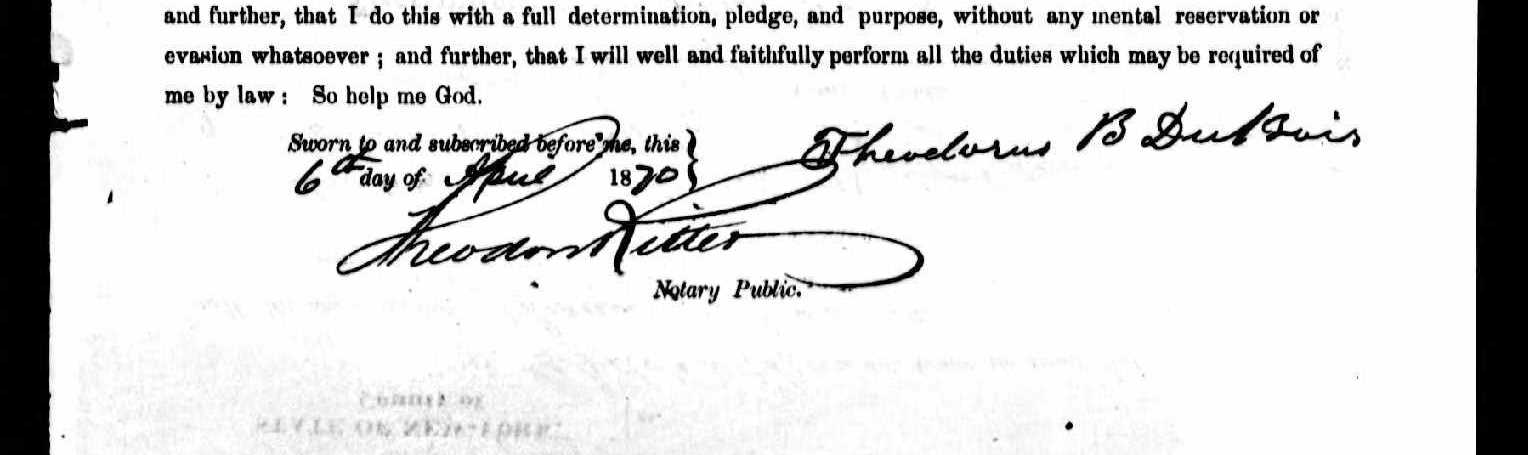
I switched the search to some of my niece’s ancestors and up popped the surprise, a passport for her Great Great Great Grandfather Theodorus B. Dubois. He stated that he was born in New York City on 11 February 1822. He applied for the passport on 6 April 1870. The year of birth matches other records. His signature is easy to read!


He was a ship’s captain and traveled all over the world. He had service in the U.S. Navy during the Civil War. His widow’s pension is on Fold3.com. The details that record holds are voluminous including much on his widow’s (Elizabeth Marfing) family.

At the bottom of the passport application is a physical description of Captain DuBois. He was 5’5″ tall, had brown eyes and dark brown hair and a beard but no color was listed for that. He had a full face, thick nose, high forehead, and a florid complexion.

The amount of information found for this man continues to amaze me. He was 6 when his father died (Thomas Koert DuBois) and 14 when his mother died (Sarah Ann Corwin).  A descendant has done DNA testing and now we await the results.


Ten Year Anniversary for Blogging: Where Are My Diamonds?

June 2, 2007 was the first time I posted on my own blog. How can ten years have passed so quickly? I checked my mail today and looked for a package outside my apartment door but apparently everyone forgot to send me diamonds for the tenth anniversary!

I had begun blogging earlier than that as the editor of the long-running FGS Conference Blog (Federation of Genealogical Societies).

There have been many ups and downs in my life in those ten years, days when the words for a post did not come to mind, and many other days when I had wonderful things to share. I have no plans to quit.

Thank you to my readers. Your support keeps me going. I don’t need the diamonds. I need my family, my genealogy colleagues, and my computer!

I already have a post planned for this weekend. A new discovery!


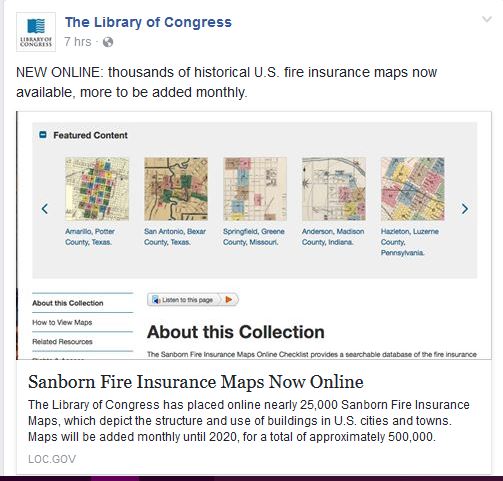
Sanborn Fire Insurance Maps on Library of Congress website

Sanborn Fire Insurance Maps are a great resource to learn more about the building in which your family lived or worked. Today, the Library of Congress announced that it is placing more online. This means free access. You might have already found some Sanborn maps accessible via a library or historical society website or on microfilm at one of these. Now, this collection will pull them all together electronically in one place when it is finished.

The maps cover about 12,000 towns and cities. They show an outline of each building and where the windows and doors are locates. Because these maps were created for insurance purposes, the maps show the property boundaries, if the is a fire wall, where the rail lines existed, street names, and what material was used in the construction of the building. You’ll learn about the nearest fire hydrant, whether the home or other building is brick or wood and what type of roofing it has. Gas lines are show. The maps cover various years from the mid 19th Century to the mid 20th Century. It’s a good way to learn more about a building that no longer stands.

For the full press release on the LOC website, click here. The image below is from the LOC posting on Facebook.


Genealogy summertime is for all-school, town, and church reunions. Are you attending?

Many family historians in the U. S. view this time of year as genealogy travel time! Visits to libraries, historical societies, archives, and courthouses increase as we search for the extensive number of records that are not online today.

Have you forgotten to add other visits to your travel itinerary? Might the ancestral areas be having an all school, town, or church reunion? Maybe it’s the annual town festival or picnic. Stop and think about the people who might be in attendance. People who knew your parents, grandparents, grandaunts and uncles, and maybe even the great grandparents. What stories might they have to share or old photographs. Which person knows about the family cemetery hidden in the woods?

How do we find out about these events? Simple online searches using the name of the school, town, or church plus reunion. Maybe the name plus words such as picnic or festival.

Is the town newspaper online? Look for a calendar of events.

Check for a genealogical society in the area and see if they have a meeting when you will be there. For any of these events, you might need to alter your trip itinerary a bit. It will be worth it!

Have a fun summer!

Free genealogy classes in Brainerd, Minnesota, June 1

I am excited to be going back to Brainerd for a day of genealogy lectures. The audience there is wonderful and the area is beautiful with lakes everywhere! The following press release is from the library. Each class is accompanied by an extensive handout.

Press Release  Genealogy Classes on June 1

Wednesday, May 24, 2017:

The Brainerd Public Library will be holding “Revealing Records: Genealogy Workshops” on Thursday, June 1, 2017.  The genealogy workshops will include three different classes scheduled at 11:00am, 1:00pm and 2:30pm.  Participants can register for as many of the free classes as they want to attend by calling the library at 218-829-5574.  All of the classes will be taught by Certified Genealogist® Paula Stuart-Warren. The classes will include:


  • 11:00am-12:00pm: Genealogical Goldmine: The Records of Old Settlers Organizations – This lecture acquaints researchers with the wealth of information that can be found in many of the records of pioneer settler organizations. Finding places of origin and settlement dates for our migrating ancestors is often difficult, but these records may provide help. Some include parents’ names, detailed accounts of the journey from the previous residence to the new location, and a listing of the members’ children. Details may include date of death, or a location in which the pioneer later resided.


  • 1:00-2:00pm: Online & On Track: Railroad Records, Indexes, and Finding Aids on the Internet – Learn about online personnel records, indexes, books, railroad employee and union magazine indexes, inventories of railroad records, indexes of insurance claims, identified photographs, and links to other free websites and finding aids.


  • 2:30-3:30pm: Lord Preserve Us! Church Records for Family History Research – Not all of our ancestors belonged to an organized religion. For those who did, the records which have survived until today can often be helpful to genealogists. Names, dates, relationships, places of new and former residences, burial location, and other details may be learned. With some background knowledge of your family, and of the area in which they lived, it may be possible to find church records for your ancestor.


Paula Stuart-Warren is a genealogical educator, researcher and consultant focusing on unusual resources, manuscripts, methodology, and analyzing records. She is a course coordinator and instructor for the Salt Lake Institute of Genealogy and the Genealogical Research Institute of Pittsburgh and an instructor for Ancestry Academy and Family Tree University and has lectured in many states and Canada. She is currently a member of the Board of Directors of the Federation of Genealogical Societies and a former board member of the Minnesota Genealogical Society. A native Minnesotan, she has researched onsite from coast to coast, written for many genealogy publications and has her own website and blog at https://genealogybypaula.com.


This free Legacy Program sponsored by your library is funded in part or in whole with money from the vote of the people of Minnesota on November 4, 2008, which dedicated funding to preserve Minnesota’s arts and cultural heritage.

Undecided about attending GRIP this summer? Need a discount?

I just received this via GEN-EVENTS. I love it when conference discounts are extended to others not able to attend!

Date: Mon, 22 May 2017 14:53:20 -0400
From: “Elissa Scalise Powell, CG, CGL” <[email protected]>
To: <[email protected]>
Subject: [GEN-EVENTS] GRIP 2017 courses discounted until May 25!

As a special from the National Genealogy Society conference, the
Genealogical Research Institute of Pittsburgh (GRIP) is offering a $40
discount until Thursday, May 25 on a 2017 course. Use coupon code “NGS2017”
when registering at www.GRIPitt.org/registration.

Elissa

Elissa Scalise Powell, CG , CGL
www.PowellGenealogy.com
www.GRIPitt.org 25-30 June 2017 and 16-21 July 2017 in Pittsburgh, PA

The Native American gems in manuscripts: Osage Nation finds Jesuit archives preserving its history

Native American genealogy research is more than locating a name on Bureau of Indian Affairs censuses, tribal base rolls*, or complete faith in a family story that you have a Indian ancestor in your background. It’s learning about how to research family history in general, finding out more about that person or person, proving the story correct or incorrect, comparing people with the same name, and pulling together a comprehensive picture of that person.

Take classes on genealogy, read books on the process, join a genealogical society, learn more about Native American research. Help yourself progress in your ancestral quest.

It’s finding church, missionary, probate, birth, death, land, and so many other records. It’s understanding the usual migrations of the tribe and the forced migrations. It’s intensive work online, in libraries, archives, historical societies and courthouses. It’s not something that can be accomplished in a weekend, a month, or even a year. DNA testing is important but is not the full story. It doesn’t tell you the tribe and may not show Native American DNA. That could be too many generations back in your ancestry. That said, please do test because researchers need all the DNA databases to keep expanding.

A recent newspaper article in the Tulsa World, “Osage Nation finds Jesuit archives preserving its history,” demonstrates that we need to uncover so much more.

From that article:

It was so much more,” said Osage Chief Geoffrey Standing Bear. “Many of the documents go to the unknown history of our tribe. It involves stories and legends that we did not know. This is very important to the Osage. This is our history. Now, we can fill in some of the unknown. The Osage tribe, in conjunction with the Roman Catholic order of priests, has uncovered what Chief Standing Bear called “a treasure trove of documents about the history of our tribe”.

Your full answers may be somewhere!

* A base roll is a census or other lists that a tribe has established as a basis for determining membership. Typically you must have lineal descent from someone on that roll or rolls that may have been compiled in 1872, 1892, or even 1938. Many of these rolls are called by nicknames related to a place or the person creating the roll. A few of these “named rolls” are the Durant, Guion Miller, Dawes, Hinton, Wallace, or the roll may be know by the year of creation such as “1888 Base Roll” or the “1906 Delaware Roll.” NOTE: there are other factors for tribes that help to determine membership. Check the tribal websites for more information.


Are you registered for “Intermediate Genealogy: Tools for Digging Deeper?”

A bit more than 2 months till the opening of the July 16-21, 2017 week of the Genealogical Research Institute of Pittsburgh(GRIP)! That means I need to get the welcome letter sent out for the students registered for Intermediate Genealogy: Tools for Digging Deeper.

The course instructors are:
Coordinator: Paula Stuart-Warren, CG, FMGS, FUGA
Instructors:
Melissa Johnson, CG
Karen Mauer Jones, CG, FGBS
Debbie Mieszala, CG
Paula Stuart-Warren, CG, FMGS, FUGA

We bring many years of knowledge, experience, and a wide array of U.S. locations to you in this course. We love to share this with you.

If you aren’t yet signed up for the course, there is still time to do that. If you wait much longer, you won’t be in time to take advantage of some special research things that apply only to this course. The welcome letter covers the details on those items.

To view all the courses offered at GRIP and to register for this annual education experience, visit the GRIP website.

Webinar sale: Conquering the Chaos: Organizing Your Genealogy Materials

I just noticed that Family Tree University is having a webinar sale. The one I am doing next Tuesday, May 23d, is half price right now. I don’t know how long this will last so sign up quickly!


Conquering the Chaos: Organizing Your Genealogy Materials

By Paula Stuart-Warren

Format: Web Seminar

Presenter:Paula Stuart-Warren
Time: 7 p.m. Eastern/6 p.m. Central/5 p.m. Mountain/4 p.m. Pacific
Date: Tuesday, May 23rd
Duration: 1 hour, including a live Q&A

Don’t Let Chaos Rule Your Genealogy Research

Are you like most genealogists? That is, do you have stacks of papers, files, certificates, census copies, and other items around your home? Do you panic when you have to find something or have to use the dining room table for a meal? Can you find what you need in your computer files? You can conquer this dilemma and learn genealogy organization tips for regularly keeping your clutter under control, with both paper and software. No one can promise perfection, but this session will share many ideas to get you on your way, including tips from some professional genealogists. We’ll even discuss some “lazy day” methods to keep you on top of your filing.

In this hour-long presentation, you’ll discover ways to keep genealogy research under control. Whether you work with paper or primarily in digital form, you’ll get tried-and-true tips for establishing and maintaining order – without losing your head.

To sign up visit the Family Tree University website.